3.11 Photography and videography jobs⧉
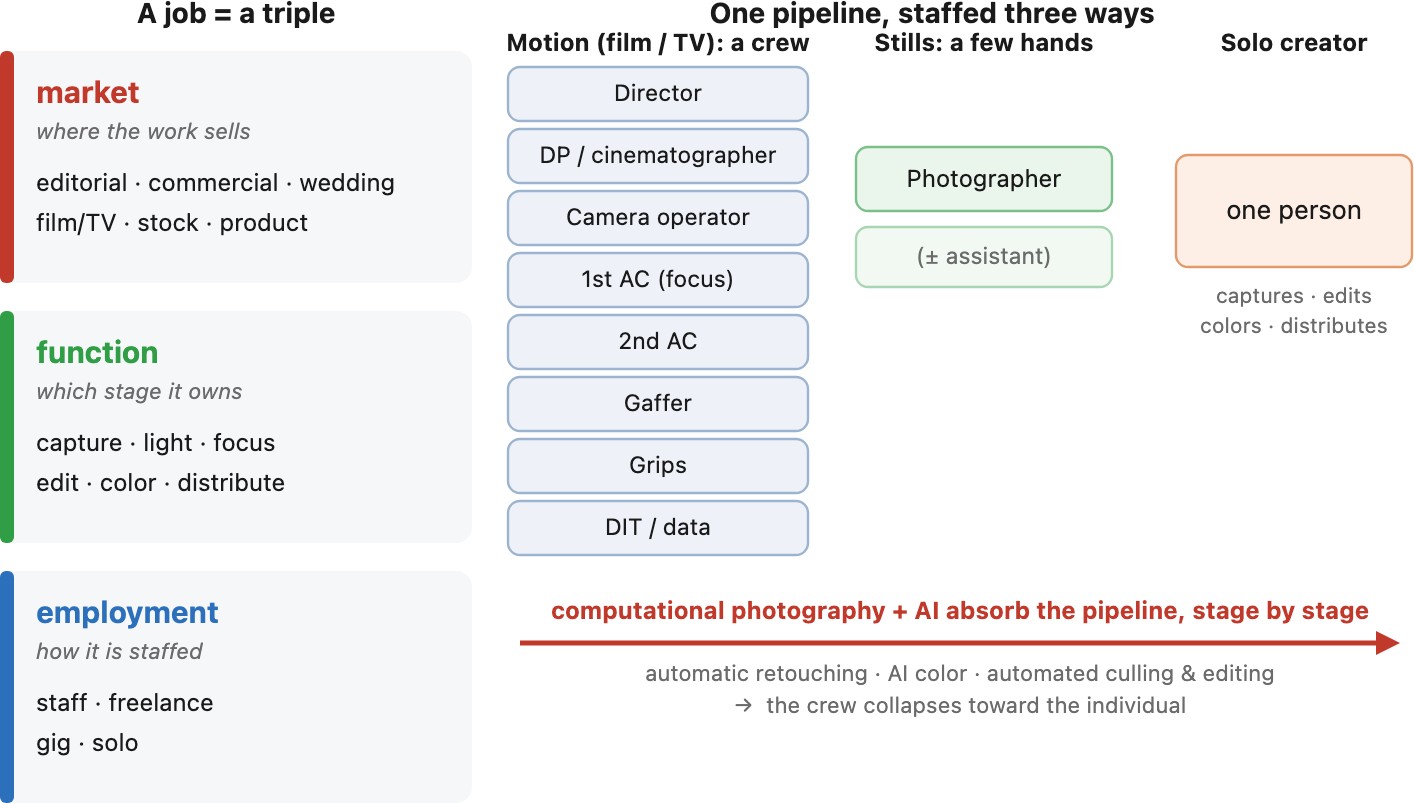
Every earlier chapter of this part treated photography as a craft: the controls, the optics, the choices. This one treats it as a living. The field employs a wide range of people, and their roles are not a flat list. They organize along three roughly independent axes, so a concrete job is a triple, one choice from each: the market it serves, the function it performs in the pipeline, and the way the work is employed. Laying the axes out separately shows how careers actually cluster, and, at the end, why the map is shifting under the same automation this book is about.
3.11.1 The market: what the image is for⧉
The strongest axis is the market, who the picture is for and who pays for it. Careers cluster here more than anywhere else, because the client sets the budget, the deadline, the size of the crew, and the whole tenor of the work.
- Consumer and social. Weddings, portraits, events, newborn and maternity and family, pets, real estate and interiors. Business-to-consumer work, usually an owner-operator running a small business.
- Commercial and advertising. Product, fashion and beauty, food, automotive, campaign work. Brand and agency clients, large productions, teams of specialists.
- Editorial and journalism. Photojournalist, documentary, sports, magazine and portrait work, staff or wire-service shooter. Deadline-driven, often staff-employed or working on assignment.
- Corporate and industrial. In-house communications, annual reports, manufacturing, architecture, headshots. Steady, unglamorous, salaried.
- Entertainment and media. Film and television, music video, the unit stills photographer on set, streaming and content. Heavily crewed and often unionized.
- Scientific, technical, and forensic. Medical and microscopy, aerial and drone mapping, remote sensing, forensic work, research imaging. This one overlaps the adjacent-fields chapter, where the camera is an instrument rather than an end.
- Fine art. Gallery and print sales, self-directed projects, teaching.
- Stock and content. Stock libraries, and the newer creator and user-generated-content economy.
3.11.2 The role: where in the pipeline⧉
The second axis is the function, where in the production pipeline the job sits. This is where stills and motion diverge most sharply. A still photograph can be made by one person; a motion production fragments the very same work across a large crew, and each rung of that crew is its own trade.
- Pre-production. Producer, casting, location scout, stylist (wardrobe, food, or prop), set designer, art director.
- Capture. For stills, often just the photographer, at most with an assistant and a digital tech. For motion, an entire hierarchy, each rung a distinct profession: the director; the director of photography (cinematographer); the camera operator; the first assistant camera (the focus puller) and the second AC; the gaffer and the lighting crew; the key grip and the grips; and the digital imaging technician (DIT), who manages the data and the on-set color.
- Post-production. Retoucher, photo editor, video editor, colorist, visual-effects and compositing artist, motion-graphics artist, and, for video, the sound roles.
- Support and business. Picture editor, agent or rep, studio manager, equipment and camera technician, archivist and digital-asset manager, educator, curator.
3.11.3 The employment model⧉
The third axis cuts across the other two: how the work is arranged. The main arrangements are freelance or assignment work, owning a studio, staff or in-house employment, agency representation, and the gig or creator model. The same title lives under very different arrangements: a wedding photographer is nearly always a sole proprietor, while a colorist may be freelance, on staff at a post house, or in-house at a brand.
3.11.4 A job is a triple⧉
A concrete job is therefore a triple: (market, function, employment). A freelance wedding photographer is consumer, capture and post collapsed into one pair of hands, freelance. A staff colorist at a post house is entertainment, post-production, staff. The triple also predicts the technical demands, which is the reason it belongs in a book about how images are made. The wedding shooter lives on fast autofocus, high-ISO denoising, and quick culling. The commercial retoucher lives in the compositing and frequency-separation world of the image-processing chapters. The DIT and the colorist are the ISP and tone-mapping chapters turned into a job description. Read this way, the technical parts of this book are not abstractions; each maps onto someone whose living depends on it.
3.11.5 How the opportunities have shifted⧉
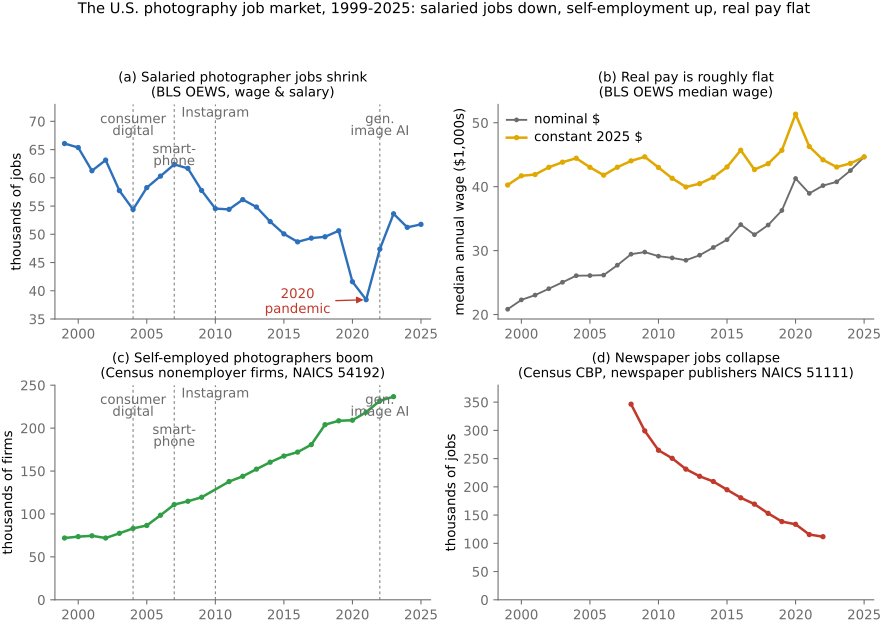
The map above is a snapshot of a moving target. Three waves of commodification have reshaped which of these jobs actually pay, each one cheapening a layer that used to be scarce and pushing the money toward whatever stayed scarce, and the shift is visible in the employment data (Figure 3.11.1).
Digital capture commodified the craft of exposure. Film enforced discipline: every frame cost money, and getting exposure, focus, and processing right was a skill that separated the professional from the amateur. Digital, and then the phone, made frames free and put a competent auto-everything camera in every pocket. Whole trades vanished with the film chain, the processing lab, the one-hour photo counter, the darkroom printer. At the same time the barrier to calling yourself a photographer fell to near zero, so the commodity end of the market, the routine portrait, the event, the real-estate walkthrough, the small-business product shot, filled with entrants and prices fell. What survived the flood was not technical execution, which the camera now handled, but the things a good auto-exposure cannot supply: access, timing, direction, and taste.
The internet commodified distribution and gutted the middle. Once images moved as files, the intermediaries thinned. Photographers reached clients directly through a website and a social feed, with no gallery or agency required, which helped the individual and hurt the broker. Stock photography, once a lucrative library business, went online, then to microstock at a dollar an image, then to free libraries, collapsing a whole income stream to a rounding error. Photojournalism took the hardest hit: as print advertising migrated to the web, newspapers shed staff photographers and leaned on wire services, freelancers, and the eyewitness phone in every pocket. Yet the same shift created demand no one had budgeted for a decade earlier: the bottomless appetite of e-commerce, social media, and content marketing for images and short video, and with it the new role of the creator who is their own studio, shooter, editor, and channel at once.
Generative AI is commodifying the image itself. Where digital cheapened capture and the internet cheapened distribution, text-to-image and generative video now cheapen production: a plausible product shot, a piece of concept art, a stock illustration, or a synthetic model can be conjured with no camera at all. Auto-retouching, AI color, and automated culling absorb the post stages that used to employ juniors. The roles most exposed are the ones whose value was the execution of a brief a model can now approximate, catalog, stock, and generic commercial imagery. New roles appear at the seams: the operator who directs and cleans up AI output, the specialist in authenticity and provenance (the C2PA and forensics thread of a later chapter) now that any image may be synthetic, and the art director whose taste steers the model. And a countervailing premium grows for exactly what a generative model cannot fake: the real event that happened only once (you cannot prompt your own wedding), the trusted document whose worth is that it was not invented, and the physical access, the mountain at dawn, the operating room, the front line, that no dataset contains.
3.11.6 The crew, collapsing toward the individual⧉
One pattern runs underneath the whole map, and it is where photography-as-craft meets the subject of this book: the division of labor tracks how much of the pipeline is automated rather than human. Motion production still fragments the pipeline across a large crew; stills has always compressed it into a few hands; and computational photography and AI are compressing it further. Automatic retouching, AI color, automated culling and editing each absorb a stage that used to be a job. This eliminates some roles, the junior retoucher and the assistant editor among them, while enabling the solo creator who captures, edits, colors, and distributes alone. So the occupational map is not static. It is the human shadow of exactly the automation this book describes, and the long arc is the crew collapsing back toward the individual as the software swallows the specialized stages. A jobs taxonomy, read this way, becomes a live commentary on where the field is heading, and a fitting place to close the practical part before the computational chapters take the pipeline apart stage by stage.