3.10 Types of photography⧉
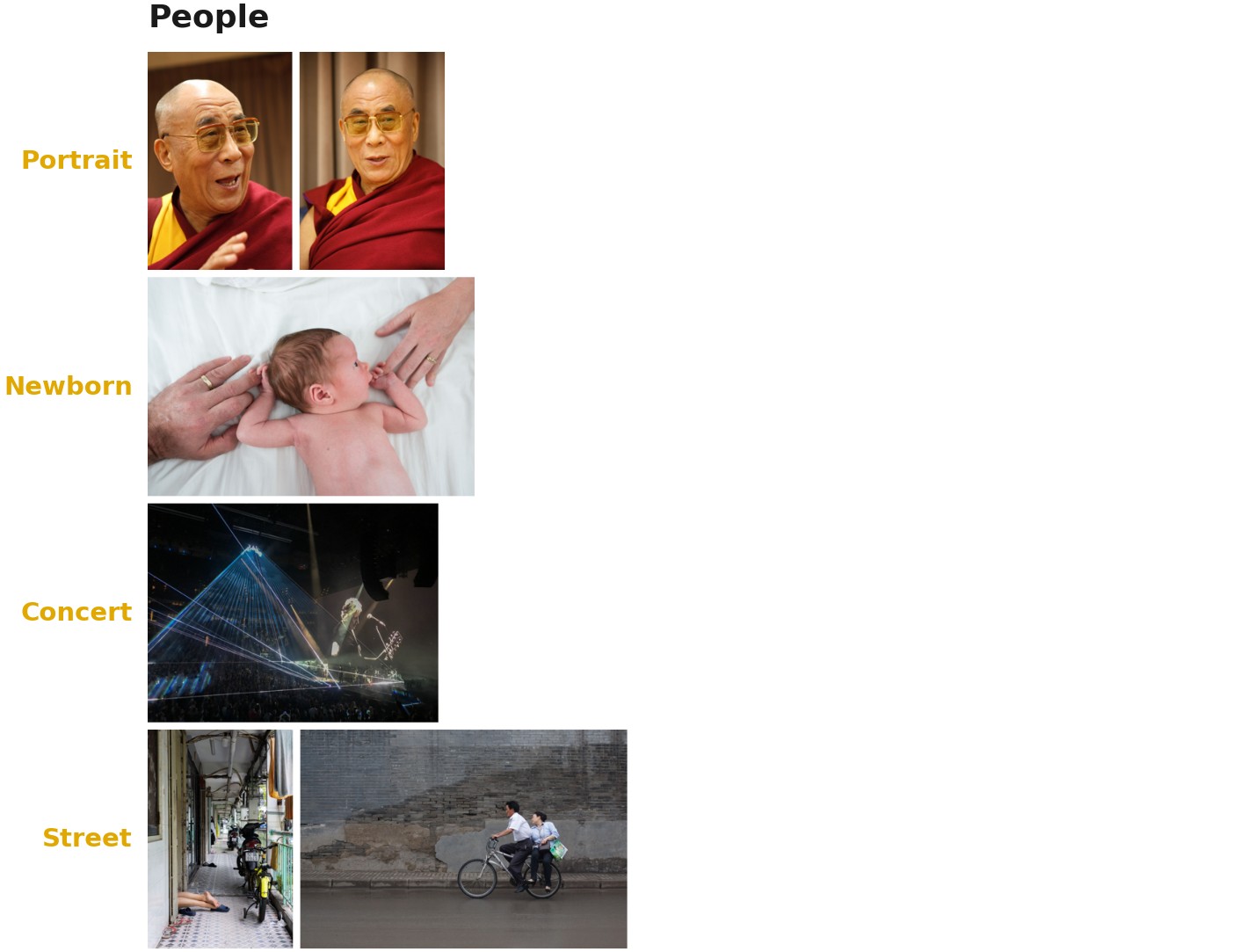
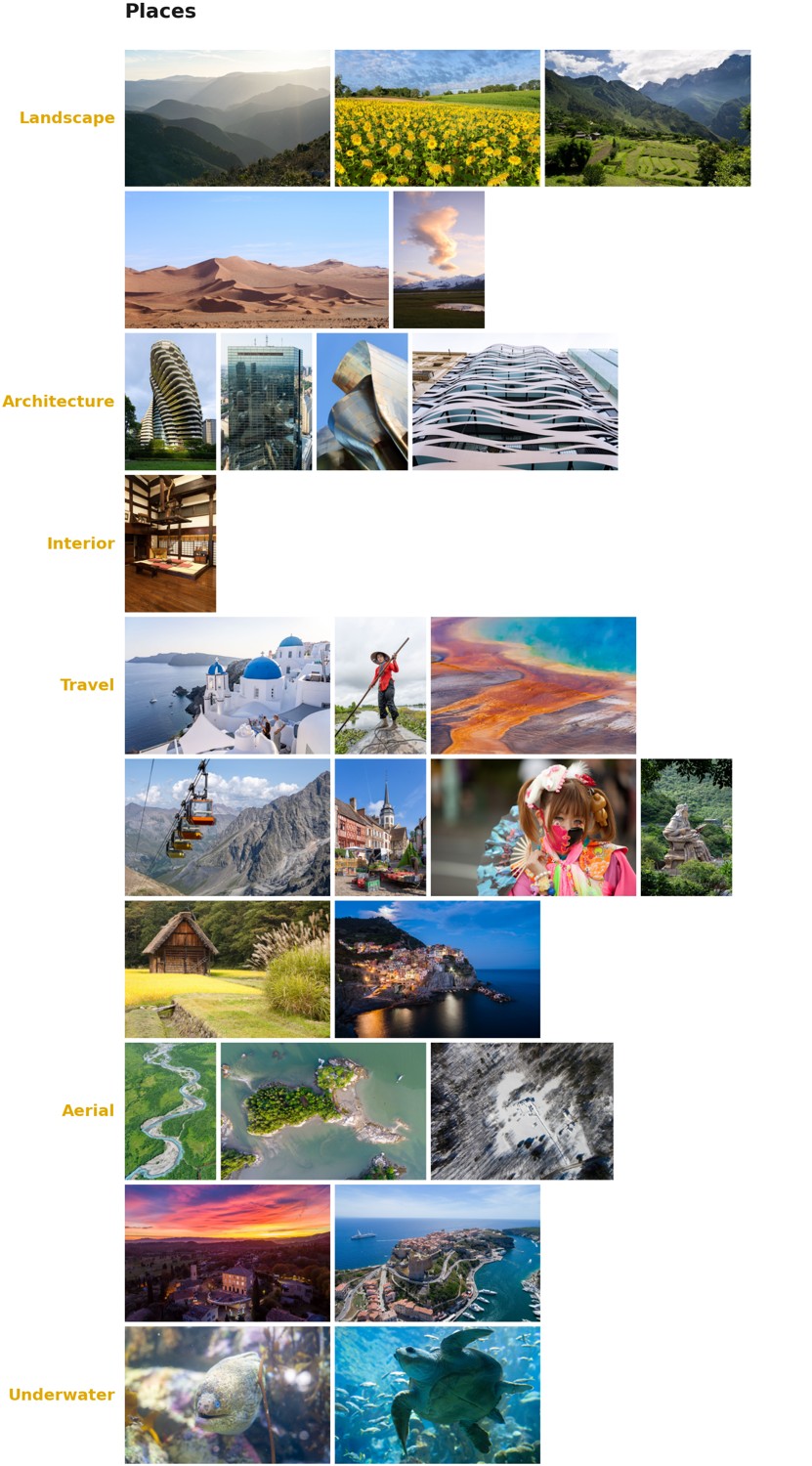
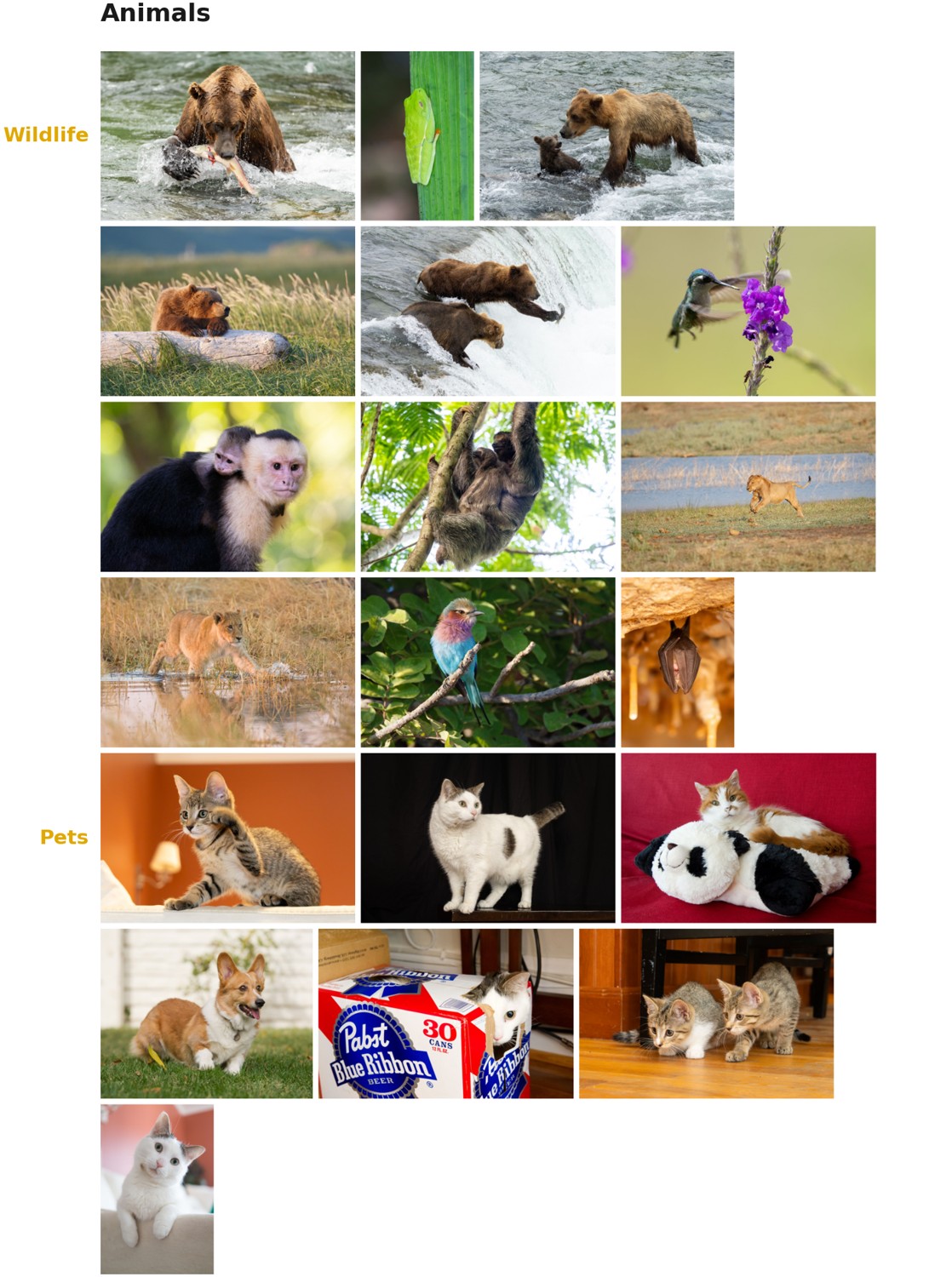
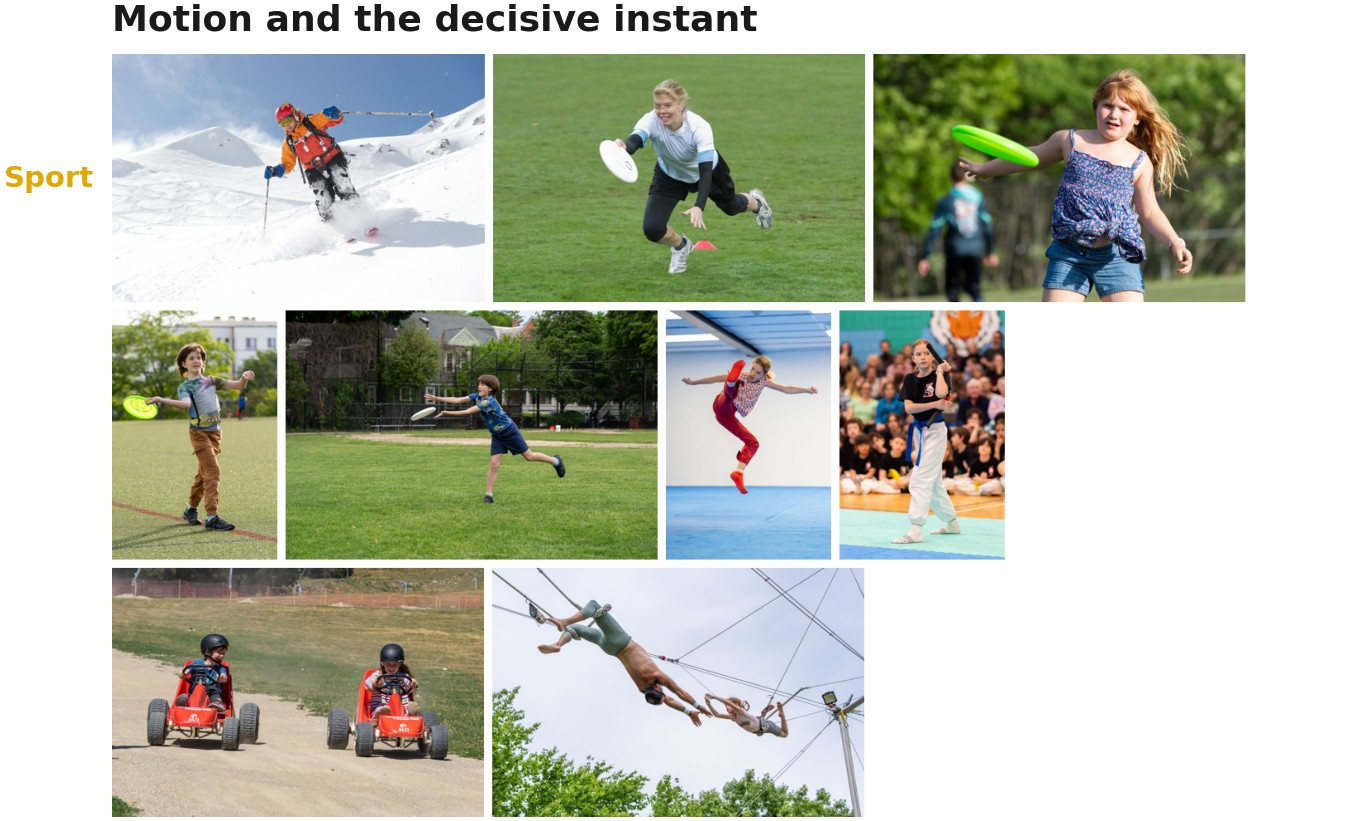
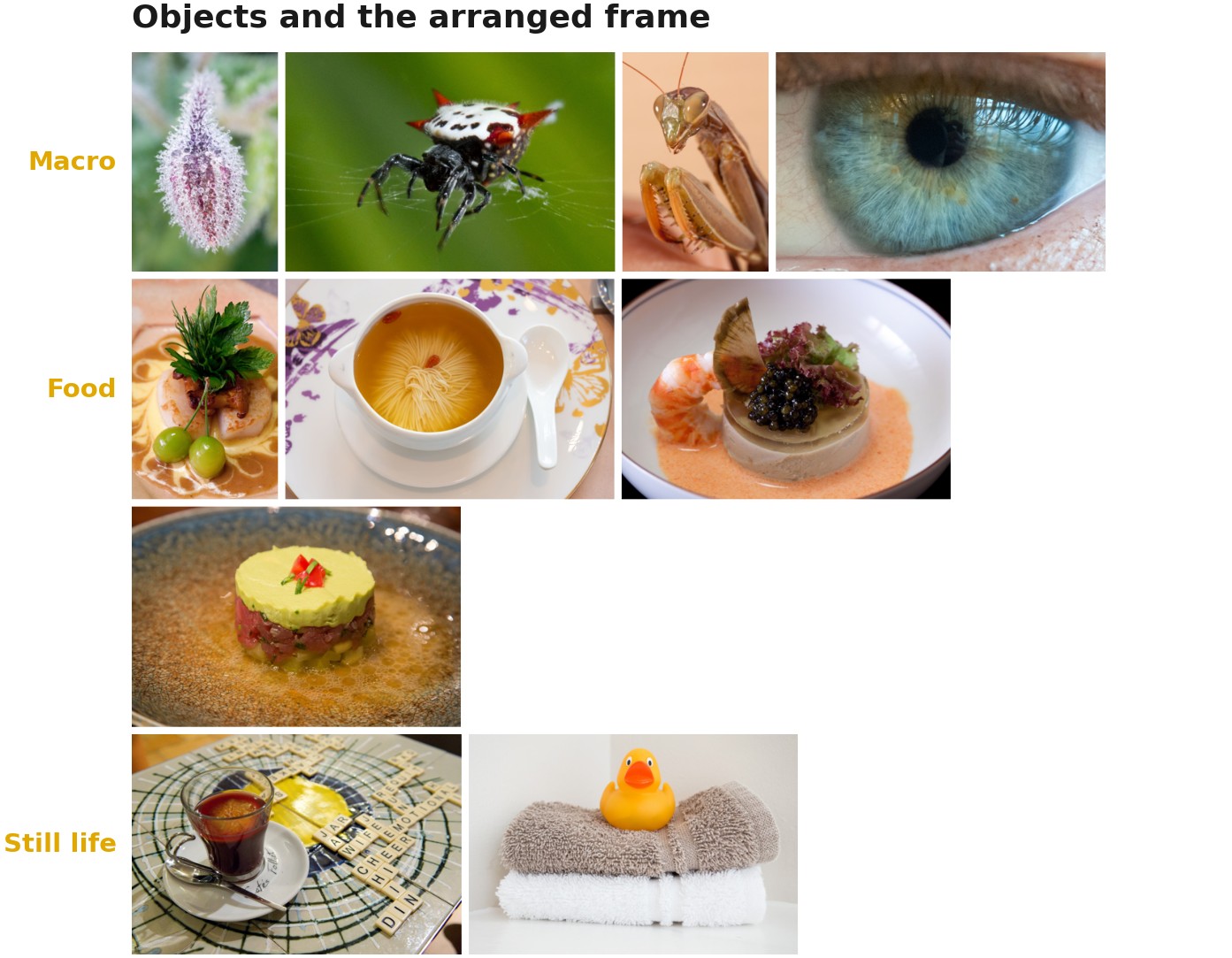
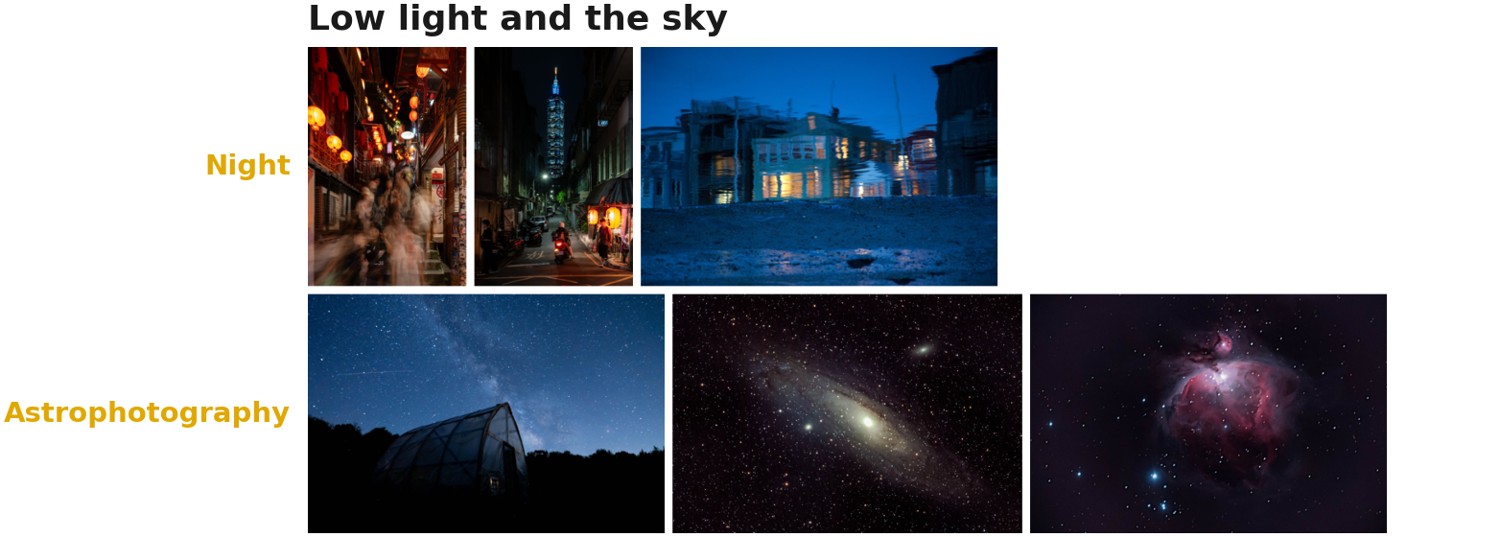
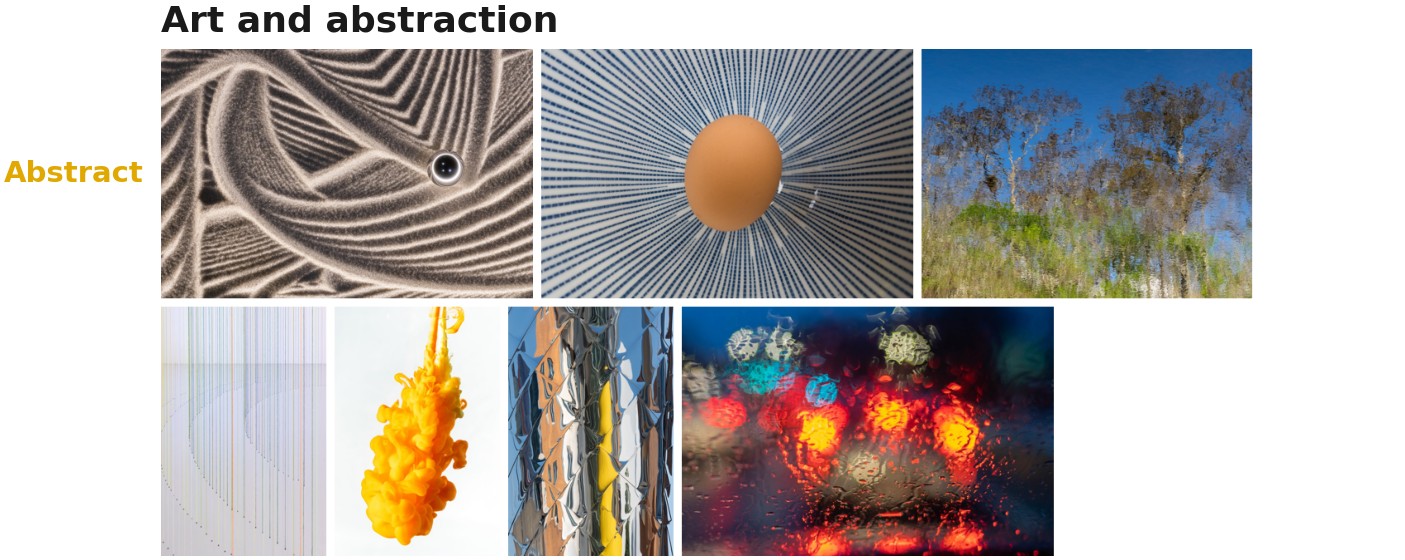
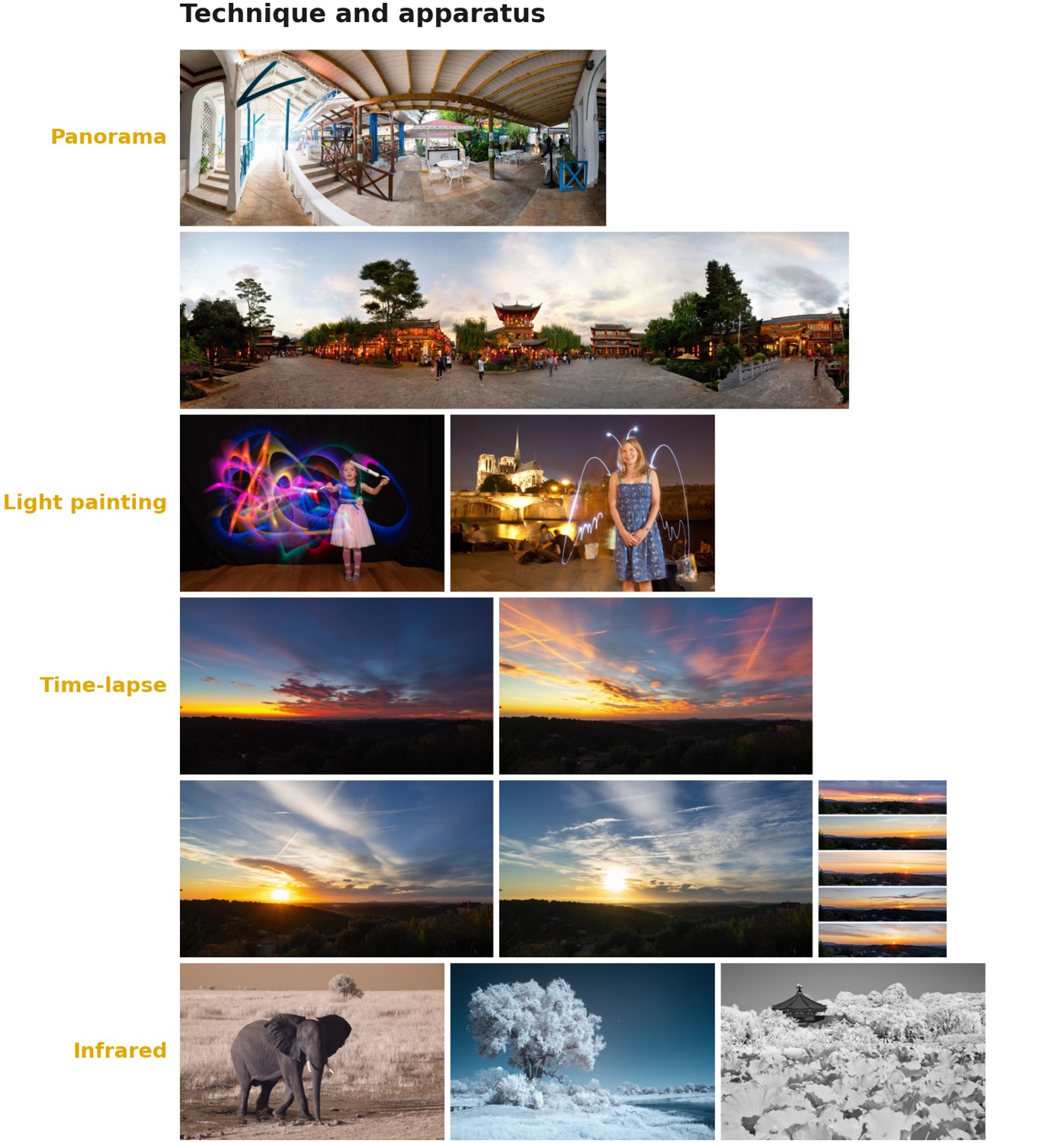
Photography is not one activity but many, and the genres are not an arbitrary list. Each is a point in a space with a few axes: the subject (a face, a mountain, a bird, a plate of food), the purpose (art, commerce, journalism, science, a personal record), the setting (studio or location, indoor or outdoor), the light regime (daylight, low light or night, mixed artificial, or fully controlled), and the technique or apparatus the image demands (a long lens, a macro rig, a drone, a converted sensor). A genre is a recurring combination of these, and, crucially for this book, that combination dictates the settings. The wildlife shooter's long fast telephoto, the macro shooter's tiny aperture, and the astro shooter's stacked frames are the exposure, focus, and motion tradeoffs of the previous chapters, specialized to a subject. The survey below walks the genres in groups, and for each gives the challenge, what a successful frame looks like, and the equipment and settings it drives. Each group is illustrated with example frames from my own archive (Figures — Figure 3.10.1, Figure 3.10.3, Figure 3.10.5, Figure 3.10.7, Figure 3.10.9, Figure 3.10.11, Figure 3.10.13, and Figure 3.10.15).
3.10.1 People⧉
- Portrait. The challenge is a flattering, expressive rendering of a face and a real connection with the subject; success is a likeness that reveals character, with clean skin tones and a separated background. Work at a short telephoto (85 to 135 mm) from a few steps back for flattering perspective, a wide aperture (f/1.4 to f/2.8) for shallow depth of field and subject isolation, eye-detection autofocus locked on the near eye, and soft directional light from a window or a large modifier. Formal and studio portraits add controlled multi-light setups and a posed subject; candid and environmental portraits trade control for authenticity, using available light and a caught moment; maternity and newborn work is a subspecialty of patience, warmth, safety, and very gentle light.
- Event and wedding. The challenge is a once-only, fast-moving day in mixed and often poor light with no second takes; success is complete, reliable coverage plus a handful of emotionally decisive frames. It rewards fast autofocus, a fast midrange zoom (24 to 70 mm f/2.8) and a fast prime, strong high-ISO performance, on-camera bounce or off-camera flash for receptions, dual card slots for safety, and brisk culling of thousands of frames afterward.
- Fashion, beauty, and editorial. The challenge is a constructed, stylized image serving a concept or a brand, made by a team; success is a striking, on-brief frame with flawless styling and light. Studio work uses controlled strobes and modifiers, medium apertures (f/8 to f/11) to hold the face and garment sharp, tethered capture, and heavy retouching (frequency separation) downstream; location editorial trades some control for atmosphere.
- Concert and performance. The challenge is very low, colored, constantly changing stage light, fast movement, and usually no flash, often from a fixed distance; success is a sharp, well-exposed, expressive frame that carries the energy. It demands fast telephoto zooms (70 to 200 mm f/2.8), high ISO with good noise control, a fast shutter (1/250 s and up) to freeze motion, continuous autofocus, and spot metering or manual exposure to survive spotlights.
- Street. The challenge is candid public life, unpredictable and fleeting, requiring speed and discretion; success is a decisive, well-composed moment with meaning or wit. Photographers favor small, quiet cameras, a normal or moderate-wide lens (28 to 50 mm), zone focus or fast autofocus, and a moderately small aperture (f/8) with a fast enough shutter to be ready without thinking.
- Photojournalism and documentary. The challenge is telling a true story under real, uncontrolled conditions on a deadline, held to an ethical bar against manipulation; success is a truthful, informative, compelling image that stands as evidence. It uses versatile fast zooms, high ISO, rugged reliable bodies, and minimal processing to preserve credibility (the ethics tie back to Photographs are usually not passive objective recordings).
3.10.2 Places⧉
- Landscape. The challenge is rendering depth, scale, and light in a scene you cannot move or control, usually at the edges of the day; success is front-to-back sharpness, balanced tonality, and a sense of place. It rewards a tripod, small apertures (f/8 to f/16) for deep depth of field, wide to normal lenses, low ISO, hyperfocal focusing, and graduated ND filters or exposure bracketing for high-dynamic-range skies (the Multiple exposure imaging chapters).
- Architecture. The challenge, mostly outdoors, is conveying a building's form and scale while controlling converging verticals; success is straight lines, even light, and a clean composition. It uses tilt-shift (perspective-control) lenses or later digital correction, small apertures for sharpness, a tripod, and patient timing for light and empty frames; the converging-verticals question ties to Photographs are usually not passive objective recordings.
- Interior. The challenge is a confined space with extreme mixed lighting (window plus tungsten plus fluorescent) and the need for wide coverage; success is a natural, inviting, balanced room with true verticals. It demands ultrawide lenses, a tripod, small apertures, exposure blending or flash to balance window and room light, and white-balance care across mixed sources.
- Travel. The challenge is a broad, unpredictable range of subjects (people, places, food, night) with one light kit and little control; success is an evocative sense of a place across varied conditions. It rewards a versatile single lens or a light two-lens kit, adaptable settings, and readiness more than specialization.
- Aerial. The challenge is shooting from a moving, vibrating platform (drone, plane, helicopter) with no tripod; success is a sharp, well-composed frame despite the motion. It needs fast shutter speeds (1/1000 s and up) to beat vibration, moderate apertures, focus at or near infinity, and, for drones, a stabilized gimbal; it shades into mapping and remote sensing.
- Underwater. The challenge is a medium that absorbs light and color with depth, drops contrast, and threatens the housing; success is color, contrast, and sharpness restored against a blue-green cast. It needs a sealed housing, strobes to put back the lost red end, wide or macro lenses (little middle ground), and getting close to cut the water column between lens and subject.
3.10.3 Animals⧉
- Wildlife. The challenge is shy, distant, fast, unpredictable animals in the field, often in poor light; success is a sharp, intimate, behavior-revealing frame with a catchlight in the eye. It is the domain of long fast telephotos (300 to 600 mm), a fast shutter (1/1000 s and up), continuous autofocus with animal-eye detection, high ISO, and patience, blinds, and fieldcraft.
- Pets and domestic animals. The challenge is an uncooperative, fast, low-to-the-ground subject; success is a sharp, characterful frame at the animal's eye level. It uses a fast shutter, continuous eye-AF, burst mode, get-down-low framing, treats and patience, and window light or bounced flash rather than direct flash into sensitive eyes.
3.10.4 Motion and the decisive instant⧉
- Sport. The challenge is fast, distant, unpredictable action with a decisive peak instant; success is a sharp subject at the peak of action against a clean, isolating background. It is built on fast telephotos (f/2.8), a very fast shutter (1/1000 to 1/4000 s) to freeze motion, or deliberate panning to convey it, continuous AF with tracking, high burst rates, and high ISO for indoor arenas (the settings of Motion blur made a profession).
- High-speed. The challenge is freezing events far faster than any shutter can, a bursting balloon, a splash, a bullet; success is a crisp frozen instant of the otherwise invisible. It relies not on the shutter but on a very short flash in a dark room, precise triggering by sound or light gates (the flash-latency point of Motion blur), macro optics, and small apertures for depth.
3.10.5 Objects and the arranged frame⧉
- Macro. The challenge is extreme magnification, where depth of field shrinks to millimeters and any motion or vibration ruins sharpness; success is a sharp, detailed subject with enough depth to read. It uses macro lenses (1:1), small apertures (f/11 to f/16) fighting diffraction, focus stacking (a multiple-exposure technique) for depth, a tripod or flash to kill motion, and diffused close light.
- Product. The challenge is a clean, accurate, appealing rendering of an object for commerce, often on white or in a built set; success is true color, controlled reflections, full sharpness, and a background ready for a clipping path. It uses studio strobes with large soft modifiers, small apertures (f/8 to f/16), tethered capture, focus stacking for small items, and careful reflection control (tents, flags, gobos).
- Automotive. The challenge is a large, glossy, reflective object whose whole surface mirrors its surroundings, shot static (a hero shot) or rolling (motion); success is clean, shaped reflections and a sense of the car's form or speed. Static work uses huge soft sources or light-painting and heavy reflection management; rolling shots use a rig or a panning follow at a slow shutter (1/60 s and down) to blur the road and wheels while the car stays sharp.
- Food. The challenge is making perishable food look fresh, appetizing, and textured before it wilts; success is appetizing color, texture, and a natural, styled scene. It rewards a food stylist, soft directional light (often backlit or from the side) to bring out texture, a normal to short-macro lens, medium apertures for a readable but not flat depth, and speed before the food dies.
- Still life. The challenge is total authorship of an arranged scene, so composition and light carry everything; success is a deliberate, balanced, expressive arrangement with controlled light. It uses a tripod, controlled continuous or strobe light, small apertures for sharpness, focus stacking when needed, and unhurried attention; it is the genre closest to painting.
3.10.6 Low light and the sky⧉
- Night. The challenge is scarce light, a high dynamic range from point sources, and the long exposures that follow; success is a clean, atmospheric frame that holds both shadow and highlight. It needs a tripod, long exposures, low ISO where possible (or careful high-ISO denoising), wide apertures, manual focus, and often exposure blending for lit signage against a dark sky.
- Astrophotography. The challenge is extremely faint light and the Earth's rotation, which smears stars during the long exposures they demand; success is sharp point stars (or deliberate trails) and faint detail pulled from noise. It uses fast wide lenses (f/2.8 or faster), high ISO, the exposure limit before stars trail (or a tracking mount), and stacking many frames to beat noise (the Multiple exposure imaging chapters at their physical extreme).
- Long exposure. The challenge, and the point, is letting time accumulate: smoothing water, streaking clouds and lights, erasing crowds; success is the intended motion rendered as silk, streak, or emptiness while the static scene stays sharp. It requires a tripod, strong neutral-density filters to allow seconds-to-minutes exposures in daylight, low ISO, small apertures, and a remote release.
3.10.7 Art and abstraction⧉
- Fine-art and conceptual. The challenge is serving an idea rather than a client or a record, so intent and coherence matter more than any rule; success is a resolved image or series that carries meaning and a personal vision. Technique is entirely subordinate to the concept, and any setting is fair game if it serves the idea.
- Abstract and minimalist. The challenge is making compelling images from form, color, texture, and negative space rather than a recognizable subject; success is a strong graphic composition that reads as design. It rewards close attention to light, pattern, and framing, often a longer lens to isolate and flatten, and precise exposure to hold clean tones.
3.10.8 Technique and apparatus⧉
- Panorama. The challenge is exceeding a single frame's field of view or resolution by stitching many; success is a seamless, distortion-controlled wide or gigapixel image. It uses consistent manual exposure and focus across frames, generous overlap, rotation about the lens's no-parallax point, and stitching software (the multiple-exposure and warping chapters).
- Composite and montage. The challenge is combining several exposures or elements into one believable, or deliberately unbelievable, image; success is consistent light, perspective, and edges so the seams vanish (or the surrealism lands). It relies on matched capture (same light and lens), masking, and compositing, and it sits squarely on the ethics continuum of Photographs are usually not passive objective recordings.
- Light painting and special effects. The challenge, and the fun, is building an image over a long exposure by moving lights, the camera, or the subject in the dark; success is the intended luminous drawing or effect cleanly rendered. It uses a dark environment, long exposures, a tripod (or deliberate camera motion), handheld light sources, and much trial and error.
- Time-lapse. The challenge is compressing slow change (clouds, stars, construction, crowds) into motion by shooting frames at intervals and playing them fast; success is smooth, flicker-free motion with consistent exposure. It needs an intervalometer, stable support, manual exposure or careful day-to-night ramping, and steady intervals; a motorized slider adds a moving camera on top.
- Infrared, ultraviolet, and X-ray. The challenge is imaging outside the visible band, which ordinary cameras filter out and ordinary optics and lighting are not built for; success is a clean image in the invisible band, revealing what visible light hides. Infrared needs a converted (IR-cut-filter-removed) camera and an IR-pass filter, giving the false-color Wood effect and dark skies (the near-IR discussion in Sensors — photosites, CCD vs CMOS); UV needs UV-transmitting optics and sources; X-ray needs a source and a detector wholly outside ordinary photography, in medical, industrial, and security imaging.
3.10.9 One frame, or a body of work⧉
A distinction cuts across every group above: how many photographs the work is actually about. Some genres pour the whole effort into a single frame. A studio portrait, a formal group photo, a fine-art print, a hero product shot, a postcard landscape: the subject holds still or can be revisited, so you can light it, reshoot it, and refine it until one image is right, and that one image is the deliverable. The craft is deliberation, and the reward is a single frame that repays close and repeated looking.
Other genres are many-photograph projects in which no single frame is the point. A wedding is complete coverage of a day plus a handful of decisive moments; a travel essay is a place rendered across a sequence; photojournalism and documentary tell a story as a set that has to hold together; sport delivers a burst from which one peak is chosen. Here success is a coherent body of work, and the decisive skill moves downstream from capture to the edit: culling thousands of frames, choosing and ordering the few that carry the story, and holding a consistent look (white balance, grade, treatment) across the set so it reads as one piece.
The consequence is practical. Single-frame work rewards patience, control, and sheer quality per frame. Multi-frame work rewards reliability, throughput, fast culling, and editorial judgment, and it makes backup, ingestion, and a repeatable processing pipeline part of the job rather than an afterthought. The same subject can sit on either side, a portrait can be one considered frame or a shoot-a-minute event take, but the tendency is real, and it shapes a photographer's day as much as the subject does.
Two threads run through the list. First, every genre is a point in the same space of choices, subject, purpose, setting, light regime, and technique, and its particular constraints are exactly what fix the settings: the long fast telephoto, the tiny aperture, the stacked frames are the earlier chapters' tradeoffs specialized to a subject. Second, these genres are how the market in the next chapter is organized: a wedding, a product, a wildlife, or a sports photographer is defined as much by the constraints above as by a client. The rest of the book supplies the tools; the genres are where a photographer decides which tools matter.