2.10 Motion blur⧉
A photograph is an integral over the exposure time (the time axis of the pixel integral, from Image measurements as integrals). If anything moves while the shutter is open, its image sweeps across the sensor and records not as a point but as a streak: motion blur. Motion blur is to that time axis what defocus is to the aperture: defocus is the smear left by integrating over the lens's solid angle, motion blur the smear left by integrating over the exposure, two faces of the same idea of a finite integral standing in for a point sample. The two are not symmetric, though. Defocus and depth of field depend mostly on distance and a handful of imaging parameters (aperture, focal length, focus), so they are largely predictable from the geometry; motion is richer, varies far more from shot to shot, and has two independent sources, worth keeping apart because they scale differently and are cured differently: the subject (the scene) moves, or the camera moves. Either way the amount of blur is set by how far the image travels on the sensor during the exposure, so everything in this chapter is a short calculation of image velocity × exposure time.
The whole subject is the flip side of depth of field. Both are sharpness limits, and both are governed by the exposure settings, so they pull against each other: stopping down for more depth of field costs light, which forces a longer exposure, which invites motion blur. You cannot have all three of deep focus, a frozen subject, and low noise in dim light; the exposure triangle is exactly this three-way bind. This chapter quantifies the motion-blur corner of it.
2.10.1 Blur from subject motion⧉
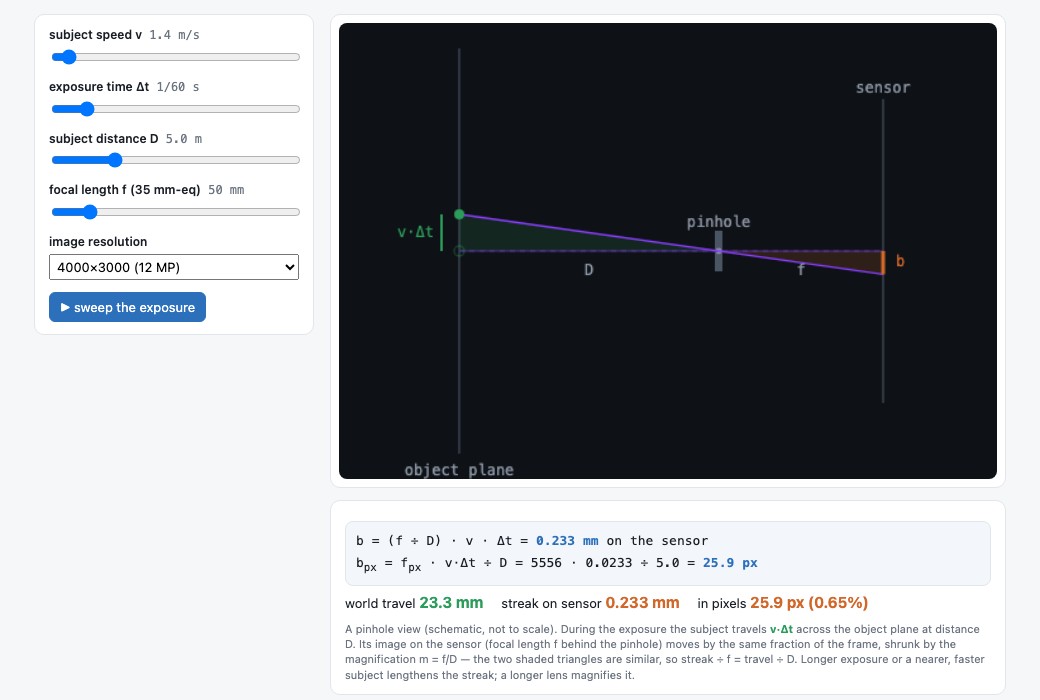
Take an object moving with velocity $v$ (m/s) across the field of view (perpendicular to the optical axis), at distance $D$, imaged by a lens of focal length $f$. During the exposure $\Delta t$ it travels a world distance $v\,\Delta t$. The lens shrinks world distances at the subject plane by the magnification $m \approx f/D$ (for $D \gg f$), so the streak on the sensor has length
and in pixels, writing the focal length in pixels as $f_{\text{px}} = f/p$ with $p$ the pixel pitch,
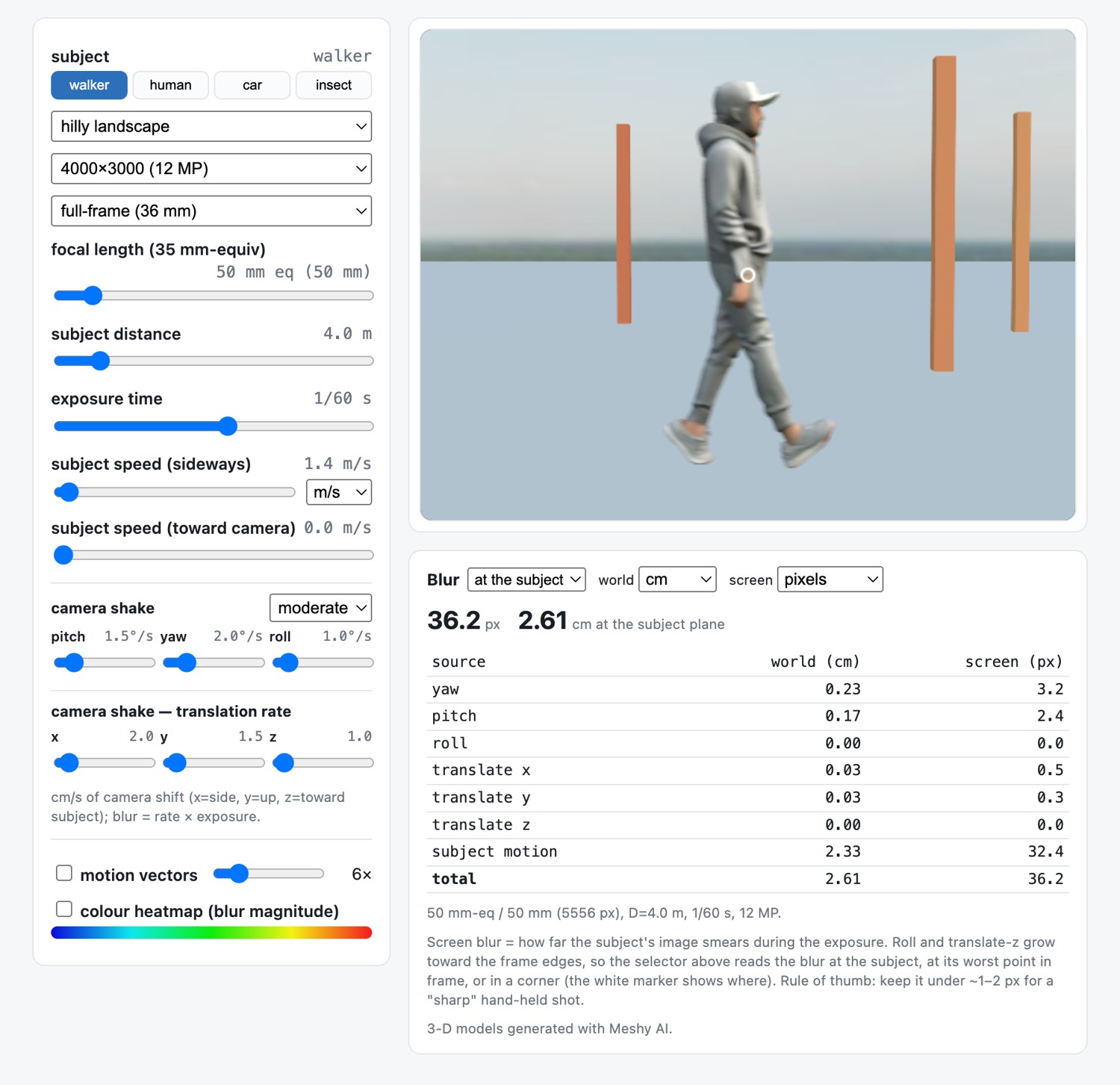
Only the component of motion across the line of sight blurs; motion straight toward or away from the camera merely rescales the object a little (a small radial blur $\propto \Delta z / D$) and is usually negligible. The result is a straight streak of that length as long as the velocity is roughly constant over $\Delta t$, which is the linearization we make: over the few milliseconds of a normal exposure, even curved or accelerating motion is well approximated by a straight segment. As a feel for the numbers, a person walking at $v = 1.4$ m/s at $D = 5$ m, shot at $50$ mm on a full-frame $24$-megapixel sensor ($f_{\text{px}} \approx 8300$) at $\Delta t = 1/60$ s, smears about $b_{\text{px}} \approx 40$ px: clearly visible, but frozen by $1/500$ s (about $5$ px).
The whole derivation is one pair of similar triangles, which is easiest to see by moving the parts (Figure 2.10.1).
2.10.2 Blur from camera shake⧉
Now hold the subject still and let the camera move during the exposure, which shifts the whole image at once. Hand tremor has two components, and they behave very differently.
The motions that cause shake are tiny, far below what the eye can follow, which is exactly why they are easy to underestimate. They can be made visible by motion magnification, which amplifies imperceptible sub-pixel movement in a video until it is plainly seen (the figure).
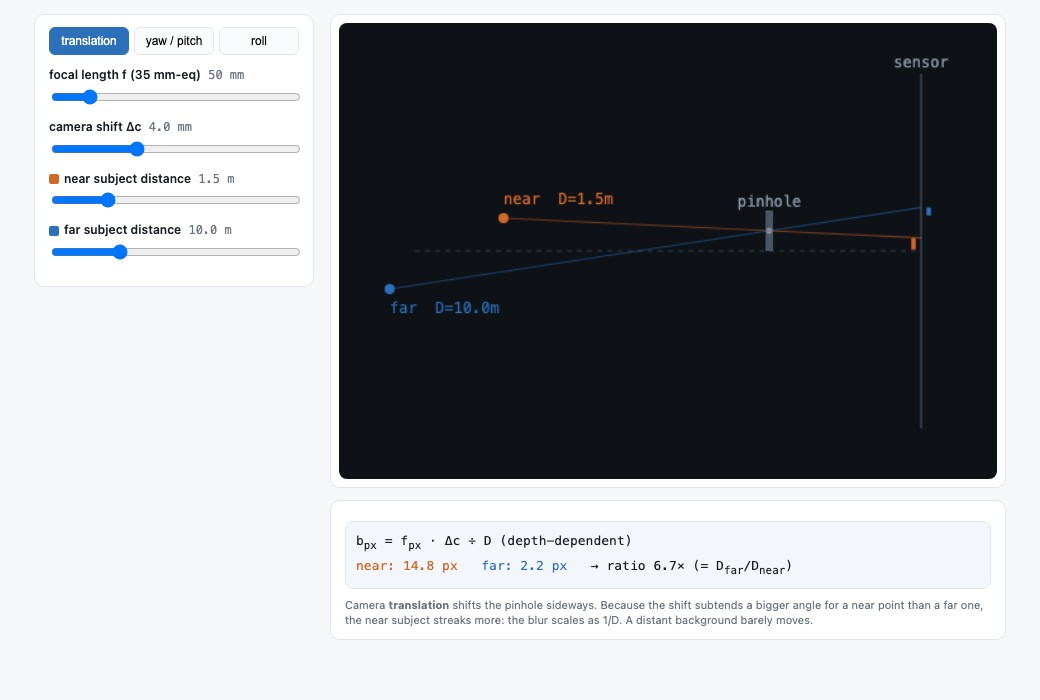
Translation. If the camera shifts sideways by $\Delta_c$ (perpendicular to the axis), it is exactly the subject-motion case with the roles swapped, applied to the entire scene:
Like subject motion, translational shake is depth-dependent: near objects blur more than far ones, and a distant background barely blurs at all. A shift along the axis by $\Delta_z$ gives a small radial "zoom" blur, $b_{\text{px}} \approx r\,\Delta_z/D$ at image radius $r$, normally tiny.
Rotation. If the camera instead rotates by a small angle $\theta$ (radians) about a horizontal axis (pitch) or vertical axis (yaw), the small-angle linearization $\tan\theta \approx \theta$ gives a whole-image shift of
The striking thing is what is absent: there is no $D$. Rotational blur is independent of the subject's distance — a rotation tilts the bundle of rays for near and far points by the same angle, so everything in the frame streaks by the same amount. Rotation about the optical axis (roll) instead spins the image about its center: a point at image radius $r$ (in pixels, measured from the center) moves by
zero at the center and growing toward the corners. Note the contrast with yaw and pitch: their blur carries the focal length $f_{\text{px}}$, so it is magnified by a longer lens, whereas roll carries only the image radius $r$, which is capped at half the frame no matter the focal length.
Camera rotation (yaw/pitch) smears the image by $b_{\text{px}} \approx f_{\text{px}}\,\theta$, the same for every object regardless of depth. Camera translation and subject motion smear it by $b_{\text{px}} \approx f_{\text{px}}\,(\Delta \text{ or } v\Delta t)/D$, which shrinks with distance. So for ordinary distances rotation dominates, and only up close (macro) does translation take over. The focal-length dependence divides the same way: yaw and pitch blur scale with $f_{\text{px}}$, so a longer lens (higher magnification) turns the same angular wobble into proportionally more blur (the basis of the $1/f$ hand-holding rule), while roll blur $b \approx r\,\theta_{\text{roll}}$ is fixed by image position $r$, not by focal length. Magnification amplifies yaw and pitch but never roll, which is why yaw and pitch usually dominate the shake blur, the more so the longer the lens. And because roll and perspective make $b$ vary across the frame, camera-shake blur is spatially non-uniform: a single blur kernel cannot describe or undo it.
The three shake terms are worth seeing as geometry rather than formulas (Figure 2.10.2), and worth adding up on a real frame (Figure 2.10.3).

2.10.3 How shift-invariant is camera-shake blur?⧉
Deblurring is far easier when the blur is the same everywhere in the frame: one kernel, one deconvolution to undo it. How close does camera shake come to that ideal? The answer depends entirely on which rotation is involved.
Take yaw and pitch first. A pure camera rotation maps the recorded image to a rotated one by a homography (a projective plane-to-plane map): in homogeneous image coordinates a point $\mathbf{x}$ goes to $\mathbf{x}' \propto K\,R\,K^{-1}\,\mathbf{x}$, where $R$ is the rotation and $K$ carries the focal length. Write the small rotation as $R \approx I + [\boldsymbol{\theta}]_\times$ and expand. The leading term is a uniform translation: to first order in $\theta$ every pixel shifts by the same $f_{\text{px}}\,\theta$, with no dependence on where the pixel sits. That first-order term is exactly a shift-invariant blur, and it is why treating a shaken photo as a single convolution works as well as it does.
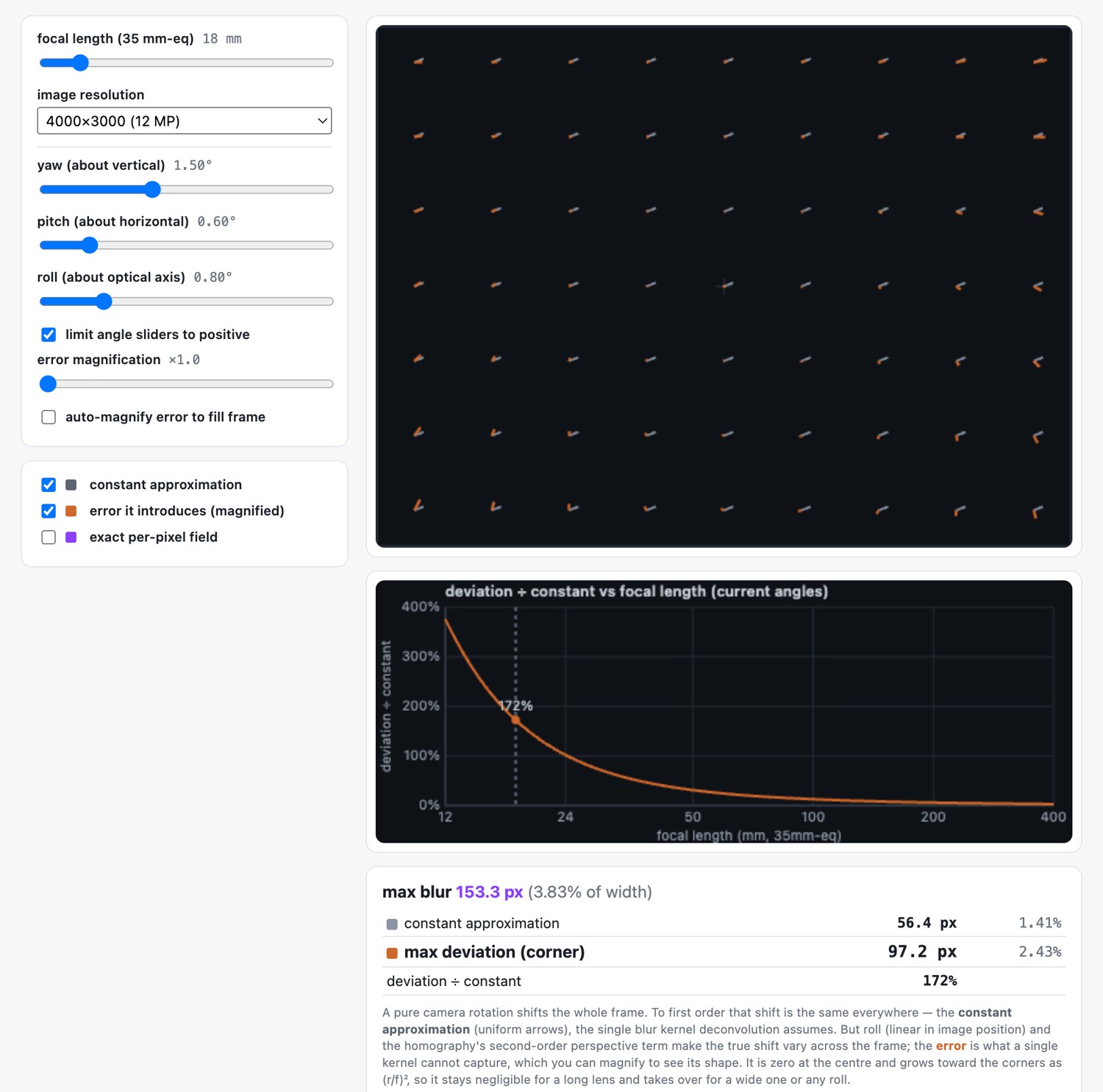
The uniformity is only the first term, though. The exact yaw shift of a point at field angle $\alpha$ (with $\tan\alpha = r/f$) is $f\,[\tan(\alpha+\theta) - \tan\alpha]$, and since $\tfrac{d}{d\alpha}(f\tan\alpha) = f\sec^2\alpha = f\,(1 + (r/f)^2)$, its expansion is
The second-order correction in (2.10.6) grows as $(r/f)^2$: a point near the edge of the frame shifts more than one at the center, and the streaks splay and curve slightly. For a long lens or narrow field ($r/f \ll 1$) the correction is negligible and the single-kernel picture holds across the whole image. For a wide lens or a large rotation it takes over fast: by the corner of a wide-angle frame ($r/f \sim 0.5$) the perspective term is already tens of percent, and one kernel no longer fits. This is the spatially-varying blur that Whyte et al. captured by modeling shake as a three-degree-of-freedom rotation instead of a convolution (Whyte et al. 2011/2014).
Roll has no such first-order reprieve. Rotation about the optical axis moves a point at radius $r$ by $b \approx r\,\theta_{\text{roll}}$, tangentially: zero at the center and growing outward. There is no uniform-shift term to fall back on, because the leading behavior is already position-dependent. Any roll at all makes the blur kernel a function of image position, from the first order up. So roll is always shift-varying, while yaw and pitch are shift-invariant only as long as the field of view stays narrow.
The practical reading: a telephoto frame shaken mostly in yaw and pitch is close enough to one kernel that ordinary deconvolution can help, but a wide-angle frame, or any roll, produces a genuinely non-uniform blur that only a spatially-varying (homography or rotation) model can undo. How far the true blur departs from a single constant kernel, and where, is worth seeing directly (Figure 2.10.4).
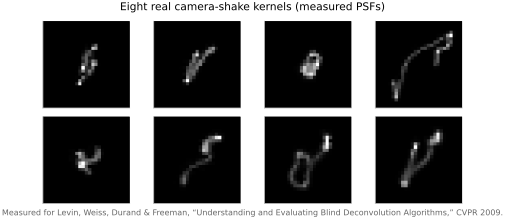
Real measured kernels bear this out. Figure 2.10.5 shows eight camera-shake point-spread functions we recorded for a blind-deconvolution benchmark (Levin et al. 2009), each the path a single point of light traced on the sensor while the camera shook: not tidy lines but wandering trajectories tens of pixels across, which is why a shaken photo needs a measured or estimated kernel rather than an analytic one. To make each blur a single spatially-uniform kernel the benchmark could evaluate against, we locked the tripod's roll axis and loosened only pitch and yaw. Left free, hand-held shake smeared the four corners of the frame differently, the direct signature of the roll and perspective terms above.
2.10.4 Which dominates: translation or rotation?⧉
Put the two camera-shake terms side by side. Their ratio is
For an everyday scene, plug in a hand tremor of order a milliradian ($\theta \sim 10^{-3}$ rad) and a millimeter of drift ($\Delta_c \sim 10^{-3}$ m) at a few meters ($D \sim 3$ m): the ratio is about $3$, so rotation already beats translation, and as $D$ grows it wins outright (the translation term dies as $1/D$ while rotation holds constant). Only in the macro regime, where $D$ shrinks toward centimeters, does $f_{\text{px}}\,\Delta_c/D$ blow up and translation dominate. So the working conclusion is that, for normal photography, camera-shake blur is essentially rotational.
This is not just a rule of thumb; it is the finding that reshaped computational deblurring. Joshi et al. strapped an inertial measurement unit (a gyroscope plus accelerometer) to a camera and measured the shake during each exposure, and the rotational signal was both dominant and the one they could recover cleanly enough to deblur with (Joshi et al. 2010) — the same gyroscope signal that image stabilization uses. Whyte et al. went further and modeled camera shake as a pure three-degree-of-freedom rotation, building the deblurring around the spatially-varying blur analysed above, which no single space-invariant kernel can match (Whyte et al. 2011/2014). The algorithms that invert these rotational and spatially-varying models are collected in the Cambridge volume on motion deblurring (Rajagopalan & Chellappa (eds.), Motion Deblurring); the single-image blind-deconvolution line that preceded them is Fergus et al. 2006, taken up in the deblurring chapter of the single-image part.
2.10.5 The hand-holding rule of thumb⧉
For ordinary distances camera-shake blur is a rotation, so if the camera turns at a roughly steady angular rate $\omega$ over the exposure, the yaw/pitch streak (2.10.4) is a direct estimate of the worst-case image displacement. Write the pixel pitch as $p = W/N$ for a sensor $W$ wide sampled at $N$ pixels across, so that $f_{\text{px}} = fN/W$, and the shake moves the image by
As a fraction of the frame the blur carries no resolution at all: it is the angular shake $\omega\,\Delta t$ divided by the angular field of view (for a modest field, $W/f$ is the horizontal field of view in radians), so a wider lens both shakes less within the frame and takes in more of the scene. Multiply by $N$ and the resolution returns linearly, which is why the same wobble looks worse on a denser sensor. For a full-frame camera ($W = 36$ mm) with a $50$ mm lens, a fairly steady hold of $\omega \approx 0.5^{\circ}/\text{s}$ (about $9$ mrad/s), and $\Delta t = 1/50$ s, this is roughly $0.02\%$ of the frame width: about $1.5$ px on a $24$-megapixel sensor and just under $2$ px on a $50$-megapixel one.
The single empirical input is $\omega$, so it helps to know what hand tremor looks like over time. The hand holding a camera never quite stops. Everyone carries an involuntary physiological tremor near $8$–$12$ Hz, small in amplitude and roughly sinusoidal (Marshall & Walsh 1956), riding on a larger and slower postural drift below a few hertz that wanders rather than oscillates. Most of the angular excursion lives in the low-frequency drift, while the crisp $\sim$10 Hz peak adds finer, faster jitter on top (Stiles 1976). Recording real exposures with an inertial sensor on the camera shows the same picture, the rotational part dominant and low in frequency (the comparison of the previous section, Joshi et al. 2010), and it is this wandering, multi-lobed path, not a clean straight line, that the measured shake kernels trace out (Figure 2.10.5, Levin et al. 2009).
Whether the steady-rate estimate in (2.10.8) holds depends on how the exposure compares with those periods. The physiological tremor cycles in about $0.1$ s, the drift in something closer to half a second or more. A short exposure, faster than roughly $1/60$ s, spans only a small fraction of even the quickest tremor cycle, so the angular velocity hardly changes while the shutter is open: the trajectory is a short, nearly straight segment, the blur grows in proportion to $\Delta t$, and a single rate $\omega$ describes it well. A long exposure, $1/8$ s and slower, spans whole tremor cycles and lets the drift double back: the angular position oscillates instead of advancing, the streak folds over itself into the tangled shapes of Figure 2.10.5, and the blur stops growing with $\Delta t$, saturating toward the peak-to-peak tremor amplitude instead. There the linear estimate fails, the blur is no longer even uniform across the frame (the earlier shift-invariance question), and only stabilization or a brief burst of light keeps the exposure sharp.
Everyday hand-held shutter speeds, $1/50$ to $1/500$ s, sit firmly in the linear regime, and that is what collapses (2.10.8) into the rule every photographer carries. Fix a blur budget of a few pixels and a typical tremor rate $\omega$: since $b_{\text{px}} = (fN/W)\,\omega\,\Delta t$, the longest safe exposure is inversely proportional to focal length, so doubling the focal length halves the shutter time you can hold. Rounded to a slogan,
so $1/50$ s for a $50$ mm lens and $1/200$ s for a $200$ mm. Longer lenses magnify the same angular wobble into proportionally more blur, so they need proportionally faster shutters. On a cropped sensor the lens frames (and shakes) like a longer one, so multiply by the crop factor and use $1/(f \cdot \text{crop})$. Two caveats sharpen it. The classic rule was calibrated for the $6$–$12$-megapixel era; as the pixel form of (2.10.8) warns, today's dense sensors viewed at $100\%$ want roughly twice as fast, about $1/(2f)$. And it speaks only to rotation shake, saying nothing about subject motion, which needs a shutter fast enough for the subject's own speed whatever the focal length.
Image stabilization rewrites the rule. In-lens (VR/OIS) or in-body stabilization reads the camera's rotation with a gyroscope and counter-shifts a lens element or the sensor to cancel it during the exposure. It buys "stops": three to five stops is typical, meaning you can hand-hold $8$ to $32$ times longer ($2^3$ to $2^5$). Four stops turns the $1/f$ rule into roughly $1/(f/16)$ — about $1/3$ s at $50$ mm. But stabilization corrects only camera motion (chiefly rotation, the term it can sense); it does nothing for subject motion. A walking person at $1/3$ s is a smear however good the stabilizer, because the stabilizer is holding the camera steady, not the person. That is the clean division of labor to remember: image stabilization fights camera shake (rotation); only a fast shutter (or a flash) fights subject motion.
2.10.6 Shake from the shutter and mirror⧉
There is a source of shake that survives even a perfect tripod and the steadiest hand: the camera shaking itself. Every mechanical exposure moves mass inside the body. On a DSLR the reflex mirror flaps up out of the light path a moment before the frame, and the shutter curtains accelerate and slam to a stop; on any camera with a mechanical shutter the curtains do the same. Each is a small hammer-blow that rings the camera for a few tens of milliseconds, and the vibration it leaves behind is exactly the sub-pixel wobble that motion magnification makes visible (the video above, the figure), accumulated over the exposure into blur.
Because the ringing is a brief transient, it does its damage in a specific shutter-speed band. A very fast exposure is over before the vibration builds; a very slow one dilutes a fixed burst of ringing across a long integration, so it barely registers. The trouble sits in between, very roughly $1/4$ to $1/60$ s, where the open shutter and the vibration's decay overlap, and it is amplified by a long lens or high magnification for the same reason hand shake is: a small angular wobble becomes many pixels through a telephoto or a macro. Mirror slap and shutter shock are the classic explanation for a frame that comes out soft on a solid tripod when everything else was right.
The fixes remove the impulse rather than fight it. Mirror lockup (MLU) on a DSLR raises the mirror first, as a separate step, then waits for the vibration to die before opening the shutter, so only the smaller shutter impulse is left during the frame; landscape and macro shooters use it routinely, usually with a two-second self-timer or a remote release so that pressing the button is not itself a source of shake. An electronic first-curtain shutter (EFCS) goes further, beginning the exposure electronically so there is no mechanical first-curtain slap at all, and a fully electronic shutter removes the moving curtains entirely. Mirrorless cameras sidestep mirror slap by construction, since there is no mirror, one quiet reason they can be easier to hold sharp, though a mechanical shutter can still shock the body until you switch to EFCS or a silent electronic shutter.
2.10.7 Panning: fighting subject motion by moving the camera⧉
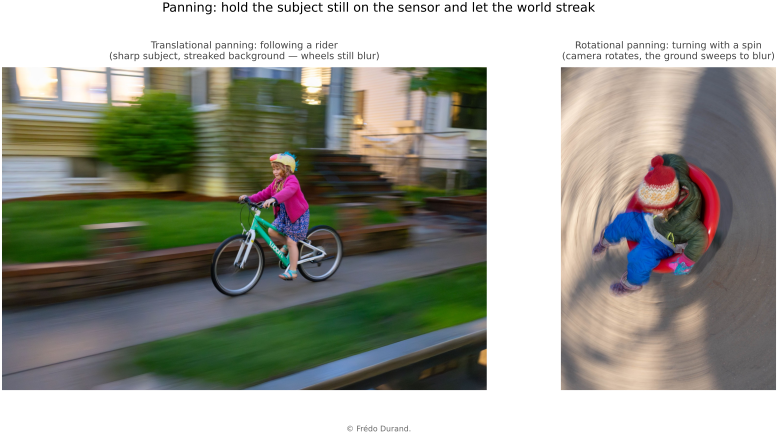
Image stabilization and a fast shutter are not the only tools against subject blur. There is a third, and it needs no electronics: panning. Swing the camera to follow the subject during the exposure so that its image holds still on the sensor while the shutter is open. Rotate at the subject's angular rate $\omega = v/D$ and its across-frame velocity is cancelled: the subject records sharp while the background streaks by the amount the subject would have. That streak is usually the point. A pin-sharp race car against a smeared track reads as speed far better than the same car frozen against a frozen background.
What panning cannot do is match the motion perfectly, and the residual is a matter of skill. Tracking a moving subject's angular rate smoothly, by hand, is a learned motor task. Write the leftover as a fraction $\rho$ of the un-panned speed: a beginner leaves a large residual ($\rho \sim 0.3$ to $0.4$), a practiced photographer perhaps $\rho \sim 0.1$, an expert a few percent. Blur scales with the leftover speed, so panning buys about $-\log_2 \rho$ stops: one to two for a novice, three to five for an expert. This is why sports and wildlife photographers pan cars, cyclists, and birds sharp at shutter speeds ($1/125$, $1/60$, and slower) that would be a hopeless smear from a locked-off camera.
Two limits bound the technique. First, panning does nothing about your own hand-shake rotation: the $1/f$ wobble rides along under the pan, so even flawless rate-matching cannot take the subject below that floor. Second, and more useful to remember, panning cancels only the motion of the rigid body you track. Anything moving relative to that body keeps its own speed: the wheels of the panned car still spin, the legs and feet of the runner still swing, the wings of the bird still beat. A well-panned motorcycle shows a sharp rider and frame with the wheels dissolved into blur, which is the look people want and also the reason the "foot", "wingtip", and "wheel" cases gain nothing from panning: no single rate freezes them. (Astrophotography runs the trick in reverse with a motorized star tracker, rotating the camera at the sidereal rate to hold the stars still while the foreground blurs.)
Panning comes in two flavours, depending on whether the tracked motion is a translation or a rotation (Figure 2.10.6). Following a subject moving across the frame is the everyday case: the camera swings and the background streaks horizontally past the sharp subject, with any part turning relative to that subject — a wheel, a foot — left blurred. Turning the camera with something that rotates sweeps the surroundings into circular blur instead; that is the star-tracker trick applied to a spinning playground disc.
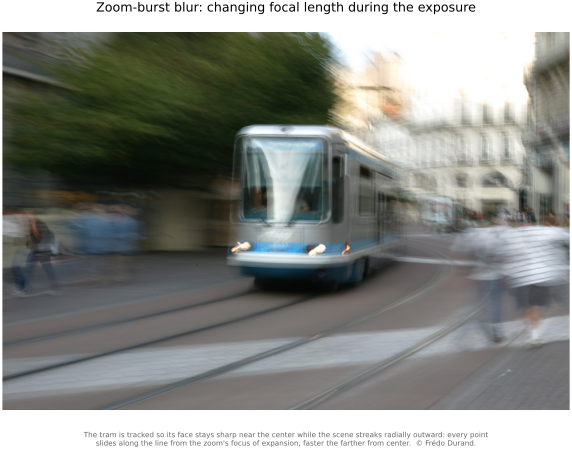
A close cousin changes not the camera's orientation but its focal length during the exposure: a zoom burst (Figure 2.10.7). Zooming while the shutter is open scales the whole image about the optical center, so every point slides along the radial line from the center at a rate proportional to its distance from it, and the scene streaks outward from a focus of expansion while the very center stays put. Track a subject at the same time and it holds sharp while everything around it explodes radially outward. It is the same idea as roll blur — a radial smear that grows with image radius $r$ rather than a uniform shift — but produced on purpose, and, like panning, it is used because the streak reads as speed and force far better than a frozen frame.
2.10.8 Freezing motion with light⧉
The shutter is not the only clock. An exposure lasts as long as light reaches the sensor, so if the light itself is brief, the effective exposure is brief no matter how long the shutter stays open. Fire a short flash in an otherwise dark room and the motion freezes to the flash's duration, not the shutter's. The shutter only has to be open while the flash fires (at or below the camera's flash-sync speed); the freezing is the flash's job. This is why a burst of flash stops indoor action even at an unremarkable shutter speed: a dancer lit only by a small flash records sharp at $1/200$ s because the burst lasted a tiny fraction of that.
Formally, when the ambient light is negligible the subject-blur equation (2.10.2) runs on the flash duration $\tau$ in place of the exposure time,
so the flash, not the shutter, sets the streak. Whatever ambient light leaks in during the rest of the open shutter adds a faint second, blurred exposure underneath the sharp flash-lit one; that is exactly the streak-plus-sharp look of "dragging the shutter" with front- or rear-curtain flash.
How short can $\tau$ be? An electronic (xenon) flash dumps a charged capacitor through a tube, and the light rises and falls in well under a millisecond. At full power a small on-camera flash lasts roughly $1/1000$ s. The useful twist is that turning the power down makes the burst shorter, not dimmer over the same interval: modern flashes quench the tube early (an IGBT switch cuts the discharge once enough light has come out), so $1/16$ power might last $1/10{,}000$ s and $1/128$ power $1/30{,}000$ s or less. That inverse link of power to duration is the central trade. A flash spends its output as energy, light multiplied by time, so a shorter burst carries proportionally less light. Freezing faster motion with flash means spending light, and past some point the frame goes dark unless you move closer, open the aperture, or raise the ISO.
Purpose-built strobes go far shorter. Harold Edgerton, at MIT, drove xenon tubes and spark gaps down to microseconds and photographed a bullet splitting a playing card and the crown of a splashing milk drop, motions no mechanical shutter could catch: a spark a microsecond long freezes a supersonic bullet to a fraction of a millimeter of travel. The same trick is within reach of any ordinary room and flash (Figure 2.10.8): a burst a fraction of a millisecond long stops a falling water drop, its rebound column, and the splash it throws up, each surface caught sharp in a moment the eye could never hold still. The price is the same one magnified. A microsecond flash is very dim, so those images are made in a dark room with the shutter held open on "bulb," the flash supplying the entire exposure and all of its timing. Timing is where the flash has a second, subtler advantage over the shutter: not just a short burst but a short and repeatable latency. A mechanical shutter's release lag is both long and variable, tens of milliseconds that drift from frame to frame, whereas a flash fires within microseconds of its trigger. That lets the flash be slaved to the event itself, a microphone catching the report of the gun, a photogate catching the falling drop, and go off at the exact instant the bullet reaches the card. When the window is a fraction of a millisecond, that precise low-latency triggering matters as much as the brevity of the burst: it is why high-speed rigs trigger the flash off the event, not the camera. Firing a strobe repeatedly during one open-shutter frame records a whole sequence on a single image (stroboscopic photography), each flash a frozen instant spaced by the strobe's period.
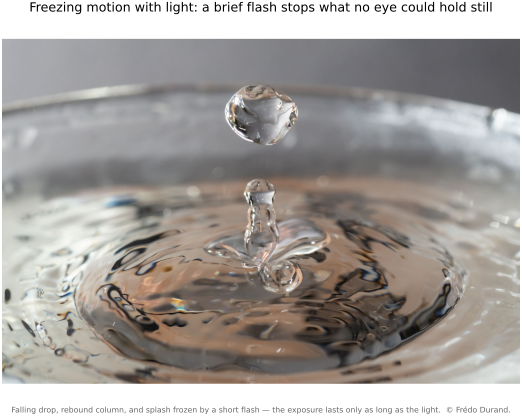
So there are two independent ways to shorten an exposure: close the shutter sooner, or light the scene more briefly. The shutter is general, working in any light but limited by mechanics to about $1/8000$ s; a flash reaches microseconds but only spends the light it carries, and only when it can outshine the ambient. High-speed photography lives on that second clock.
All of these relationships — the two causes, the distance dependence, the rotation-versus-translation balance, and the hand-holding budget — are easiest to feel by driving them, so the chapter closes on a calculator that renders the actual blur in 3-D and reports it in both world and screen units (Figure 2.10.9).
The everyday question, though, is usually the blunt one: how fast a shutter do I need to freeze this? The chapter's second calculator (Figure 2.10.10) answers it for a menu of common motions, from a walker to a tennis serve to the stars, and shows how the answer moves with framing and with panning skill.

Recap: big lessons of this chapter
Camera rotation (yaw/pitch) smears the image by $b_{\text{px}} \approx f_{\text{px}}\,\theta$, the same for every object regardless of depth. Camera translation and subject motion smear it by $b_{\text{px}} \approx f_{\text{px}}\,(\Delta \text{ or } v\Delta t)/D$, which shrinks with distance. So for ordinary distances rotation dominates, and only up close (macro) does translation take over. The focal-length dependence divides the same way: yaw and pitch blur scale with $f_{\text{px}}$, so a longer lens (higher magnification) turns the same angular wobble into proportionally more blur (the basis of the $1/f$ hand-holding rule), while roll blur $b \approx r\,\theta_{\text{roll}}$ is fixed by image position $r$, not by focal length. Magnification amplifies yaw and pitch but never roll, which is why yaw and pitch usually dominate the shake blur, the more so the longer the lens. And because roll and perspective make $b$ vary across the frame, camera-shake blur is spatially non-uniform: a single blur kernel cannot describe or undo it.