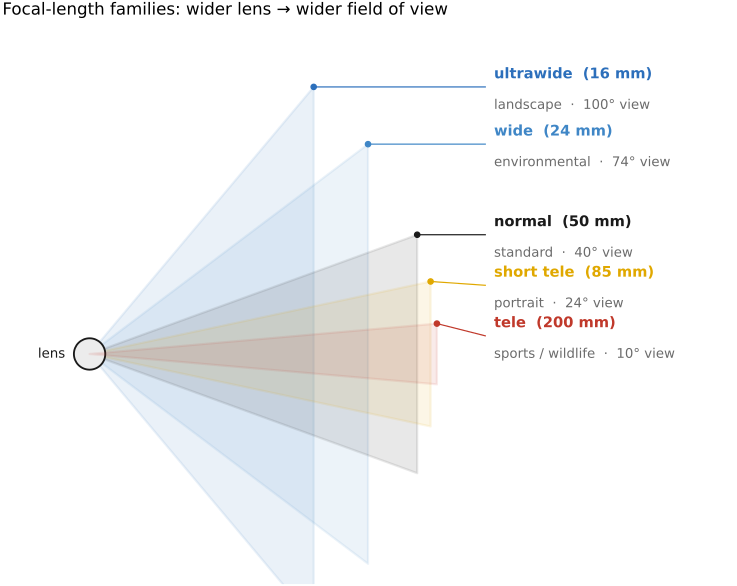
• effect on light (linear, quadratic). Why f/# are a ratio: same amount of light (divide fov, compensate with aperture)
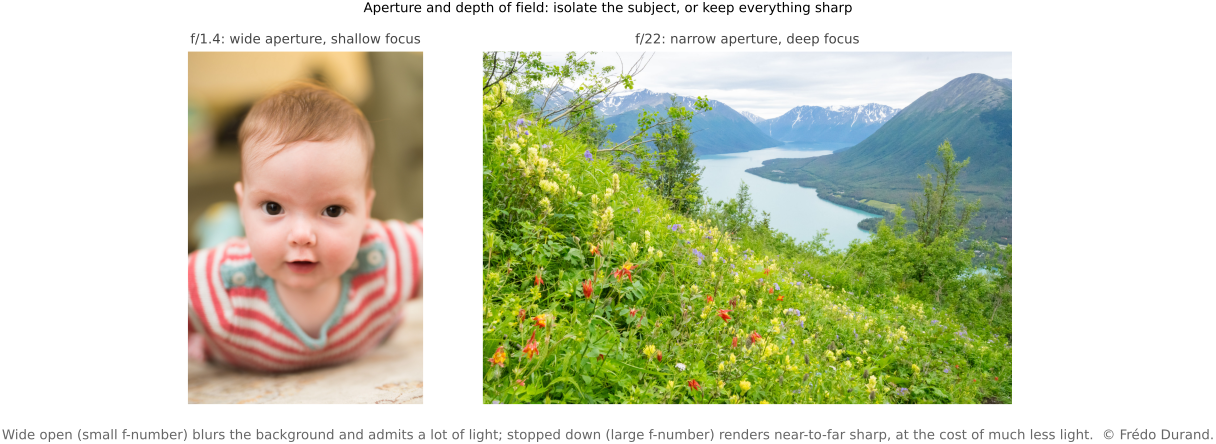
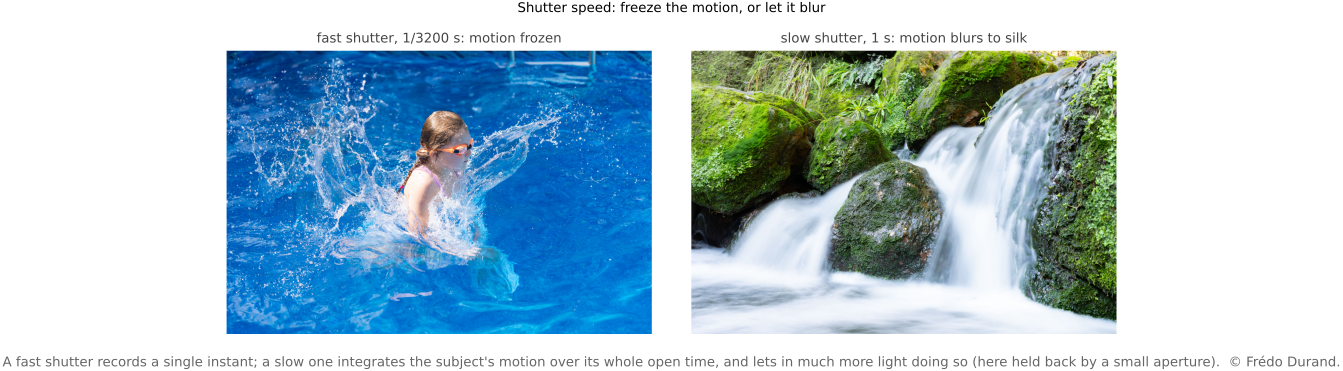
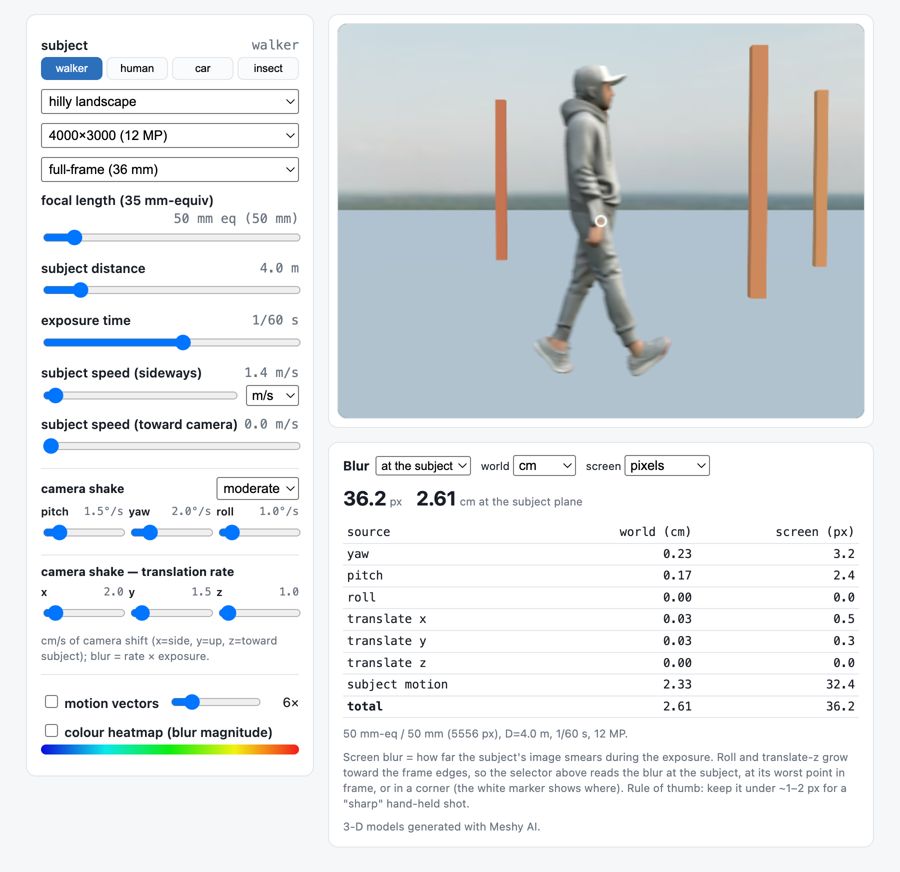
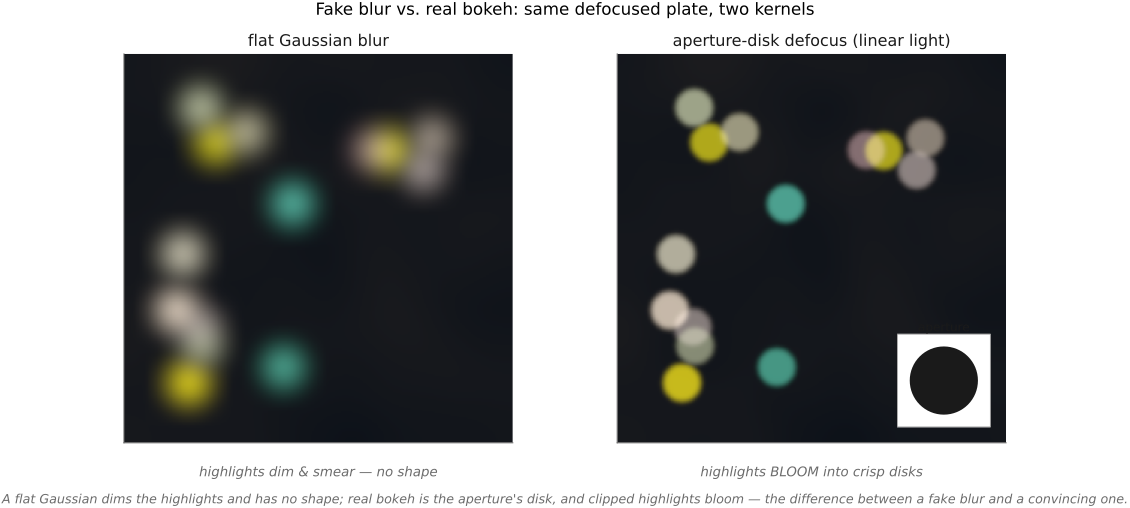
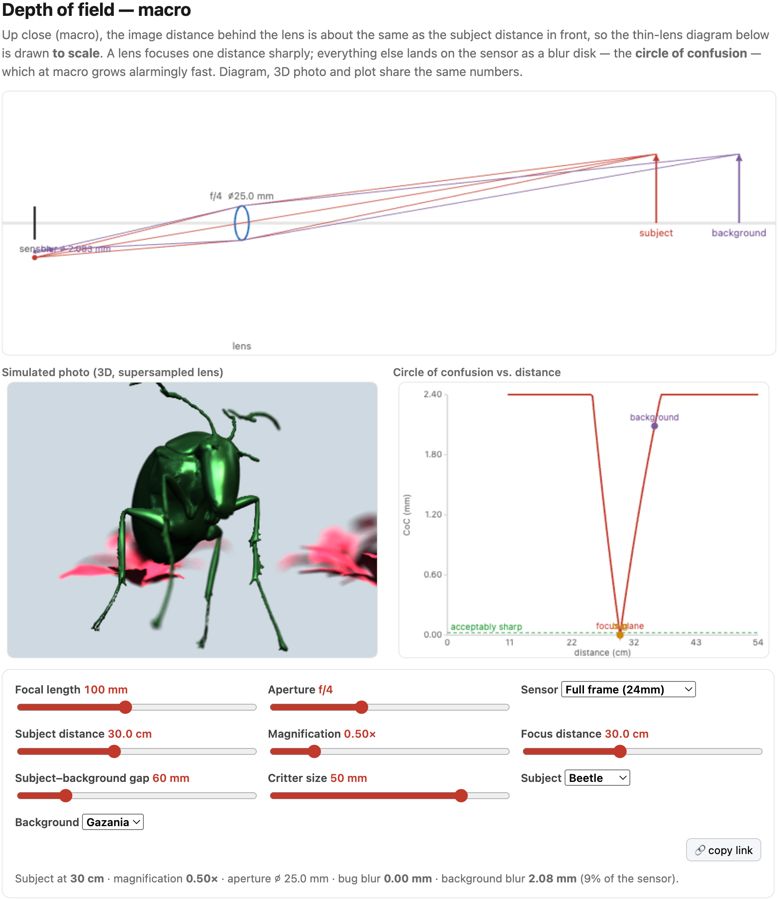
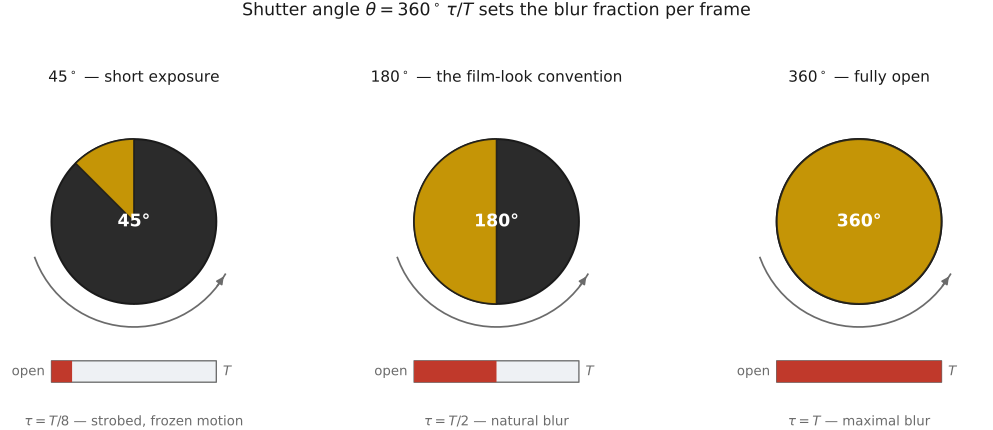
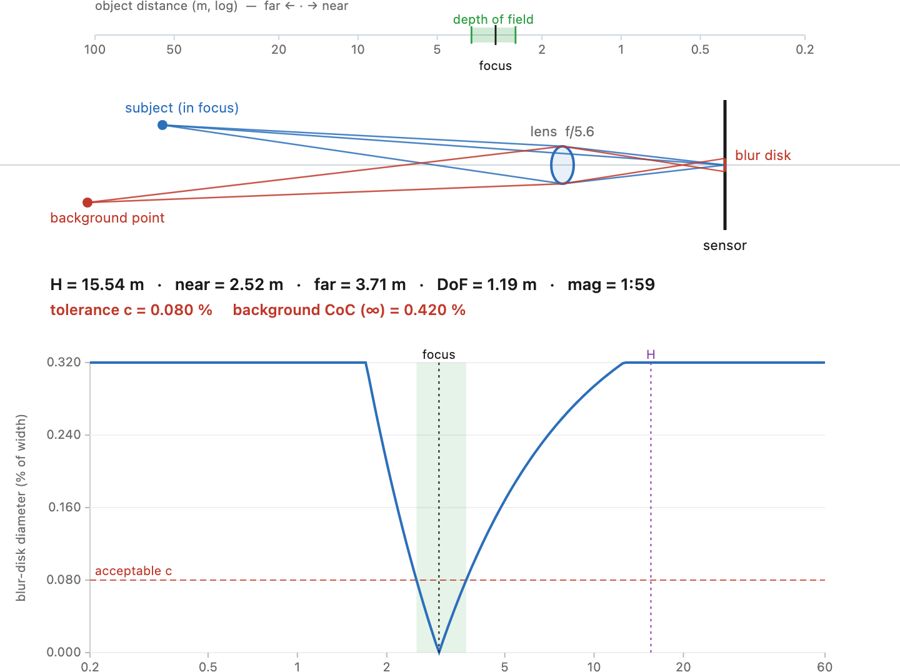
• side effects (motion blur, depth of field). Will derive later
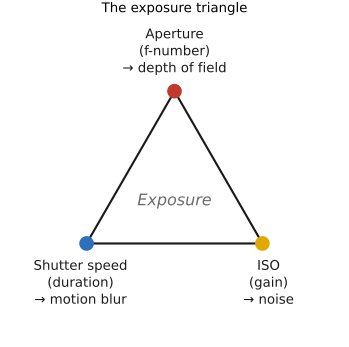
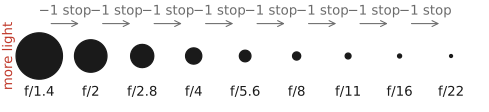
• **f-stops are a log₂ (doubling) scale of light**: the *f-number* itself is a **ratio** N = f/D, but what a photographer counts is **stops**, and **one stop = a factor of 2 in light**. Because light ∝ aperture **area** ∝ D² ∝ 1/N², the standard series **1.4, 2, 2.8, 4, 5.6, 8, 11, 16** steps by **√2 in N** so the area (and the light) **halves** each step. A "stop" is therefore a **log₂ unit**: $\text{stops} = \log_2(\text{light ratio})$ — and aperture, shutter time, and ISO are all measured in this same stop currency, which is exactly why you can trade one against another (the exposure triangle). Cameras add **⅓-stop** clicks for fine control. [f-stop power-of-two progression figure]
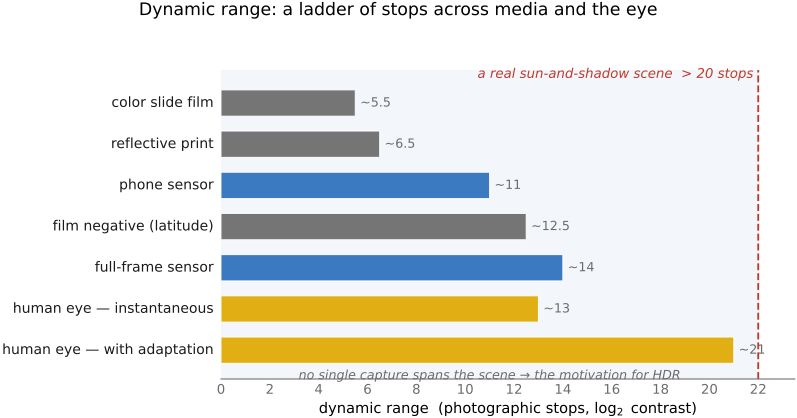
• 💡 **Big lesson:** **photographers measure light in *stops* — a log₂ (doubling) scale.** Aperture, shutter, ISO, and dynamic range are all counted in stops (factors of 2), so **exposure is additive in log space** — the same "ratios matter, work in log" principle as gamma and tone mapping.
• 🖱️ **Interactive (web edition):** a live **exposure-triangle simulator** — two 3D subjects at different depths walk in opposite directions while you set shutter, aperture, ISO, scene brightness, and sensor size; it renders the scene *physically* (time supersampling → real motion blur, aperture supersampling → real depth of field, a shot+read-noise model → real ISO grain), and an "auto-set triangle" holds the exposure constant so you feel each control's trade-off, not just its brightness. [fig-exposure-triangle-sim; interactive]
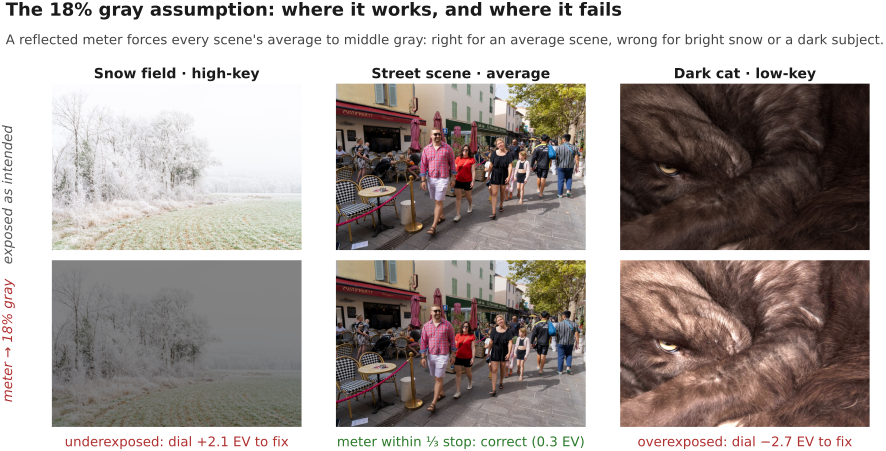
• **autoexposure & metering**: the meter integrates scene light (TTL — center-weighted / **spot** / **evaluative-matrix**) and renders it to a **mid-gray (~18%) assumption**, which **fails on high-/low-key scenes** — a snowfield meters to gray and comes out *underexposed* (you add +EV); a black cat meters to gray and comes out *overexposed*. Matrix metering (e.g. Nikon's 3D Color Matrix, trained on tens of thousands of photos) adds brightness/color/contrast/distance cues to guess intent. [18%-gray metering figure]
• **where does 18% come from?** it's the reflectance of the standard photographic **grey card** and the meter's stand-in for the *average reflectance of a "normal" scene*. The key idea: **18% is middle grey *perceptually*, not numerically** — because lightness is roughly **logarithmic** (Weber–Fechner; cf. CIE $L^*$), the perceptual midpoint between a black (~2–3% reflectance) and a white (~90%) sits near their **geometric mean** (√(0.03·0.9) ≈ 0.16), i.e. ~**18%**, *not* 50%. It is **Zone V** of Ansel Adams's Zone System (the middle of eleven zones). A meter's job is then "assume the scene averages to middle grey, and expose so that average lands at middle grey."
• 💡 **the radiometric meaning of (shutter, aperture, ISO) — a worked example (and why not to trust it).** The three controls aren't arbitrary dials: they tie the photo to **absolute scene radiometry** through two calibrated relations.
• **ISO is calibrated to the sensor** (ISO 12232). The **saturation-based speed** is $S_{\text{sat}} = 78 / H_{\text{sat}}$, where $H_{\text{sat}}$ (in **lux·s**) is the focal-plane *luminous exposure* that just **saturates** the sensor; so a higher ISO means less light is needed to fill the well. (The standard also defines SOS / REI variants tied to a mid-grey output level — which is partly why bodies disagree.)
• **the exposure (metering) equation** ties the controls to scene **luminance** $L$ (cd/m²): a "correct" (middle-grey) exposure satisfies $\boxed{\,N^2/t = L\,S/K\,}$, with $N$ the f-number, $t$ the shutter (s), $S$ the ISO, and $K \approx 12.5$ the meter calibration constant (ISO 2720).
• **worked example** — **f/2.8, 1/100 s, ISO 400.** The scene luminance this renders to middle grey: $L = K\,N^2/(t\,S) = 12.5 \times 2.8^2 / (0.01 \times 400) = 12.5\times 7.84/4 \approx \mathbf{24.5\ \text{cd/m}^2}$. The **focal-plane exposure** actually delivered to the sensor follows the *camera equation* $H = q\,L\,t/N^2$ with the lens factor $q=\tfrac{\pi}{4}T\cos^4\theta \approx 0.65$ on-axis (DxO uses $q=0.71$): $H \approx 0.65\times 24.5\times 0.01/7.84 \approx \mathbf{0.020\ \text{lux·s}}$. Sanity check against saturation: at ISO 400, $H_{\text{sat}}=78/400 = 0.195$ lux·s, so middle grey sits $\log_2(0.195/0.020)\approx\mathbf{3.3\ \text{stops}}$ below clipping — that's your highlight headroom. So a bare $(t,N,S)$ triple **does** pin down scene radiance in real units.
• ⚠️ **but two big caveats** before you believe the number. **(1) the nominal values lie** — the marked/EXIF $N$, $t$, $S$ are not the true ones (rounded shutter, manufacturer-tuned ISO that can be **⅓–1 stop** off the measured value; → [[Basic image processing and ISP#Beyond the pixels: basic metadata and EXIF]], [@burggraaff-etal-2019]). **(2) not all pixels see the same light** — lens **vignetting** and the **cos⁴θ** natural falloff (→ [[Sensors: photosites, CCD vs CMOS]]) mean **edge pixels get less light than the centre** for the same scene radiance, so "absolute radiance per pixel" needs a per-lens **flat-field** correction, not one global scalar. Honest radiometry therefore **calibrates the actual body + lens + aperture** rather than trusting the triplet. (DxOMark's "measured ISO" is exactly this saturation-based calibration; their old *ISO-sensitivity* measurements page is now folded into the [DxOMark glossary → ISO speed](https://www.dxomark.com/glossary/iso-speed/) and the [sensor-testing protocol](https://www.dxomark.com/dxomark-camera-sensor-testing-protocol-and-scores/).) [refs: ISO 12232; ISO 2720; [@burggraaff-etal-2019]]
• caveat (the **18 vs 12.5%** confusion): light meters are actually calibrated to a fixed **luminance constant** ($K$, ISO 2720) that, with typical lens flare, corresponds to **~12–13%** reflectance — so the famous "18% card" and the meter's true midpoint differ by **~⅓–½ stop**; metering off an 18% card gives a slightly different exposure than the meter's internal target, a perennial source of forum arguments.
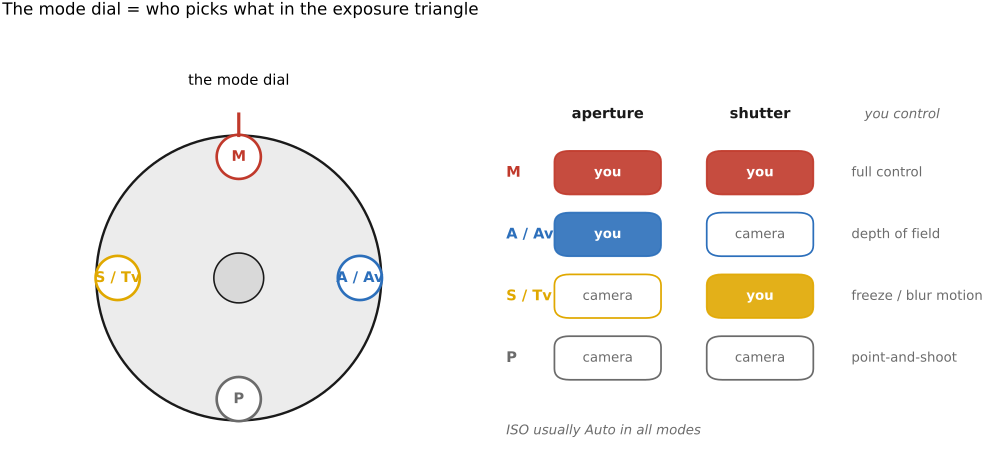
• **priority modes & their failure cases**: aperture-priority (set N, camera picks t) and shutter-priority (set t, camera picks N) — each fails when no valid partner exists (f/1.4 in bright sun needs an impossible shutter; 1/1000 in dim light needs an impossible aperture)
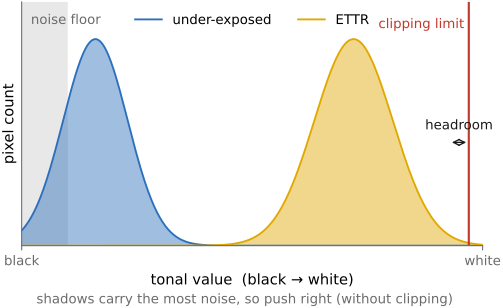
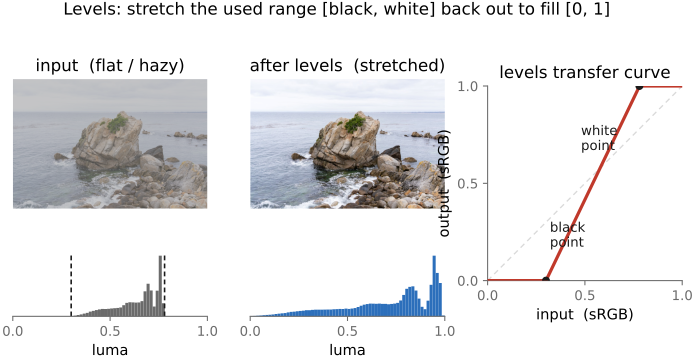
• **"expose to the right" (ETTR)**: push the exposure as bright as possible **without clipping** highlights, since the **shadows** are where noise lives; **raising ISO** beats brightening in software because ISO gain amplifies the signal *and* the pre-amplifier noise but **not** the downstream **read noise** (→ Noise) [ETTR histogram]
equationsexposure ∝ t·(D/f)²
one stop = ×2 light = 1 EV
EV = log₂(N²/t)