3.9 Photographs are usually not passive objective recordings⧉
A photograph carries a peculiar authority. It looks like an automatic trace of the world: light fell through a lens onto a sensor, and no one's hand seems to have intervened between the scene and the print. That impression of mechanical objectivity is exactly what makes a photograph persuasive in a way a painting is not, and it is mostly a myth. The claim of this chapter, taken from Durand and Dorsey's depiction lecture, is blunt: at every stage between the world and the print, the photographer makes a choice. The choices are invisible precisely because the result still looks like reality. The picture's truth-claim is borrowed from its resemblance to an automatic recording, while in fact it is the product of dozens of decisions. The word usually in the title matters: there are systematic, capture-everything efforts (Street View, sky surveys, light fields) that get genuinely closer to an objective record, and we come to them, and to the new biases they carry, at the end.
The flip side of that borrowed authority is that a photograph is never an idle act. It does something in the world, which is the plainest sense in which it is not a passive recording (Figure 3.9.1).
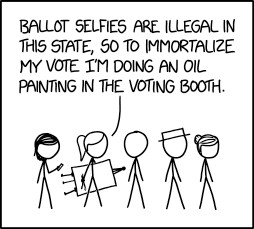
The naïve position has a perfect spokesman: Calvin, of Calvin and Hobbes, who insists a photograph is the literal truth. The chapter challenges that view, not to debunk photography but to describe it clearly. The thread is old. The quest for realism runs from the Greeks to the Renaissance to photography to computer graphics, and each new medium was sold as the one that finally made depiction objective. None was, because the premise is wrong from the start: there is no neutral, innocent naked eye whose seeing a camera mechanically copies. Vision is itself active and inferential. And that last point is the deepest one in the chapter, so it deserves a careful statement.
This is not an idiosyncratic or merely rhetorical stance. Aaron Hertzmann has made the same case squarely within vision science, arguing that photography, exactly like painting, results from deliberate choices of color, tone, framing, and perspective, and that there is no dividing line between the two (Hertzmann 2022, "The choices hidden in photography"; and, less formally, his essay "Photography is not objective"). Even a "#nofilter" phone snapshot inherits a manufacturer's hidden decisions: a default tone curve, a color-rendering style, a sharpening and noise-reduction recipe, a face-brightening and sky-tuning pass, all applied before you ever see the image (the pipeline of Auto-exposure and auto white balance and the processing chapters). The right way to understand pictures, Hertzmann argues, is to treat photography as one way of making pictures, on the same continuum as drawing and painting, rather than as an objective record that painting only approximates. That is precisely this chapter's thesis, reached independently from the side of perception, and it is worth knowing that the two literatures, depiction and vision science, converge on it.
3.9.1 Faithful is not the same as realistic⧉
Human vision does not report raw luminance and raw geometry; it discounts the accidental conditions of a scene to recover the things that matter. We see a sheet of paper as white under a blue sky and under a tungsten bulb, though the light reaching the eye is wildly different, a case of color constancy (color constancy). We read a tilted coin as round. We do all of this before any camera is involved. The consequence, which NPAR draws out, is genuinely counterintuitive: a physically accurate recording can look less true than a manipulated one, because the manipulated one may better match what the visual system would have inferred from the real scene. Faithful and realistic are not the same thing. The gap between them is the space the photographer works in.
The whole debate lives between two credos. Turner: "My business is to paint not what I know, but what I see." Picasso: "I do not paint what I see, I paint what I know." And Hogarth's anecdote sharpens it: a Chinese emperor, shown a Western portrait modeled with chiaroscuro shadow, is said to have read it as a man who had lost half his face, because the convention of "shading a face to suggest its form" had to be learned before it could be read as realism. Even our most "objective" pictorial devices are conventions. A further point: by choosing the depiction situation — a particular viewpoint, a fill light to open the shadows — the maker of a 2-D picture influences the scene being depicted, a situation Durand likens to the observer's influence on the observation. The photographer is inside the system, never outside it looking in.
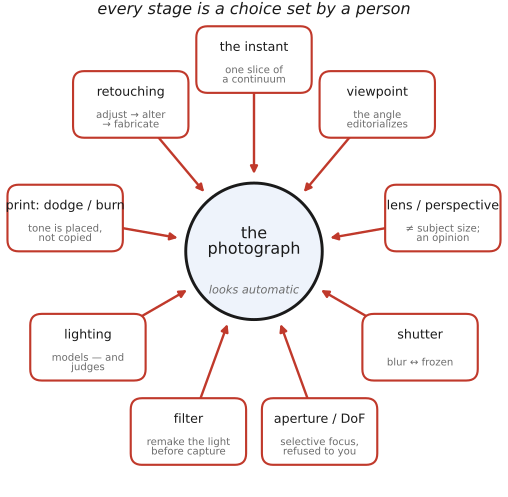
The rest of the chapter makes the abstract claim concrete by walking the degrees of freedom of photography, the controls set at each stage. There are many of them (Figure 3.9.2).
3.9.2 Choosing the instant, choosing the viewpoint⧉
The most "objective" act in photography is also a radical authorial one: selecting the instant. Out of a continuum, the photographer keeps one slice, Cartier-Bresson's decisive moment, and that choice is the photograph (Cartier-Bresson 1952). The extreme case makes the paradox vivid. Edgerton's strobe catches a bullet passing through an apple, an instant no human eye can ever see. Is it realistic? It is certainly real. Yet it lies entirely outside human experience. Objectivity and human realism have already come apart.
The viewpoint is not innocent either. A house shot from a scaffold tower and the same house from the ground make different statements; a hand thrust into the foreground over a crowd editorializes. The clinching demonstration: two press photographs of the same event, framed differently, can read in opposite ways. "The camera doesn't lie" does not survive contact with two truthful photographs of one moment.
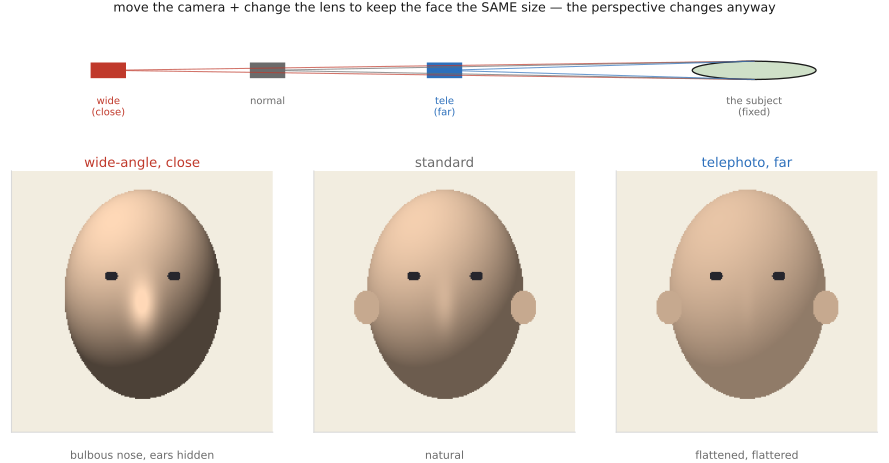
The subtlest and most useful point in this section is that perspective is not the same as subject size. It is tempting to think a longer lens just enlarges the subject. It does not. Keep a face the same size in the frame by stepping back and reaching for a longer lens, and the perspective changes completely: the modeling of the nose and cheeks, and above all the face's relationship to its background. A wide lens used close gives a bulbous nose and a yawning background; a short telephoto from farther back flattens and flatters. The lens is an opinion about the face. Pull focal length against camera distance in opposite directions and you get the dolly-zoom, the queasy shot Scorsese uses in Goodfellas (Figure 3.9.3). A useful inversion: a "corrected" image can read as more truthful than a faithful one. Converging verticals are optically correct (we really do look upward at a tall building), yet they feel wrong, so we straighten them with a view-camera shift, a perspective-control lens, or in software; the corrected building is less optically faithful and more acceptable. By the same token, marginal distortion, spheres at the edge of the frame projecting as ellipses, the outer columns of a colonnade looking fattest, is inherent to linear perspective, not a defect of the lens; Da Vinci already noticed it (linear perspective). The viewpoint can even manufacture an outright lie that the camera then records "faithfully": the forced-perspective tourist holding up the leaning tower, or the Ames room, a distorted room that, seen from one fixed station point, makes one person a giant and another a doll.
3.9.3 Speed, aperture, and focus: the photographer rules⧉
Even a single exposure has two free parameters: shutter and aperture trade off against each other (reciprocity), and each affects the image. A slow shutter smears a moving subject into blur; a fast shutter freezes a bullet in mid-air. The same scene becomes two different realities depending on a dial.
Aperture sets depth of field, and here the chapter lands its sharpest "the photographer rules" point. Selective focus, using a wide aperture that blurs everything but the subject, isolates and directs; deep focus, everything sharp front to back, "never happens for human vision" in the first place. But the real asymmetry is this: in a real scene, you could shift your focus wherever you pleased, glancing from the near face to the far doorway at will. A photograph fixes one focal plane forever and refuses you that freedom. The photographer has decided, once, where your eye is allowed to be sharp. (It is exactly this dimension that light-field imaging later hands back, letting the viewer refocus after the fact, and it connects to the fixed-focus and hyperfocal choices of lens image formation.) A control presented as a neutral property of optics is, on inspection, a decision imposed on the viewer.
3.9.4 Filters and lighting: building the scene's light⧉
Before the light is ever "recorded," a filter can remake it. A diffusion filter softens and quietly steers attention; a graduated neutral-density filter darkens a too-bright sky so the foreground can then be exposed up, rebalancing the scene's tones in camera; a polarizer strips reflections and deepens a blue sky depending only on its orientation; a star filter manufactures a starburst that was never there; a red filter cuts bluish haze, so that the very "atmosphere" of the photograph is a choice. And colored filters for black-and-white map colors to gray differently, so even the monochrome "record", seemingly the most austere and objective of all, is authored: the same face yields different tonalities depending on the filter on the lens.
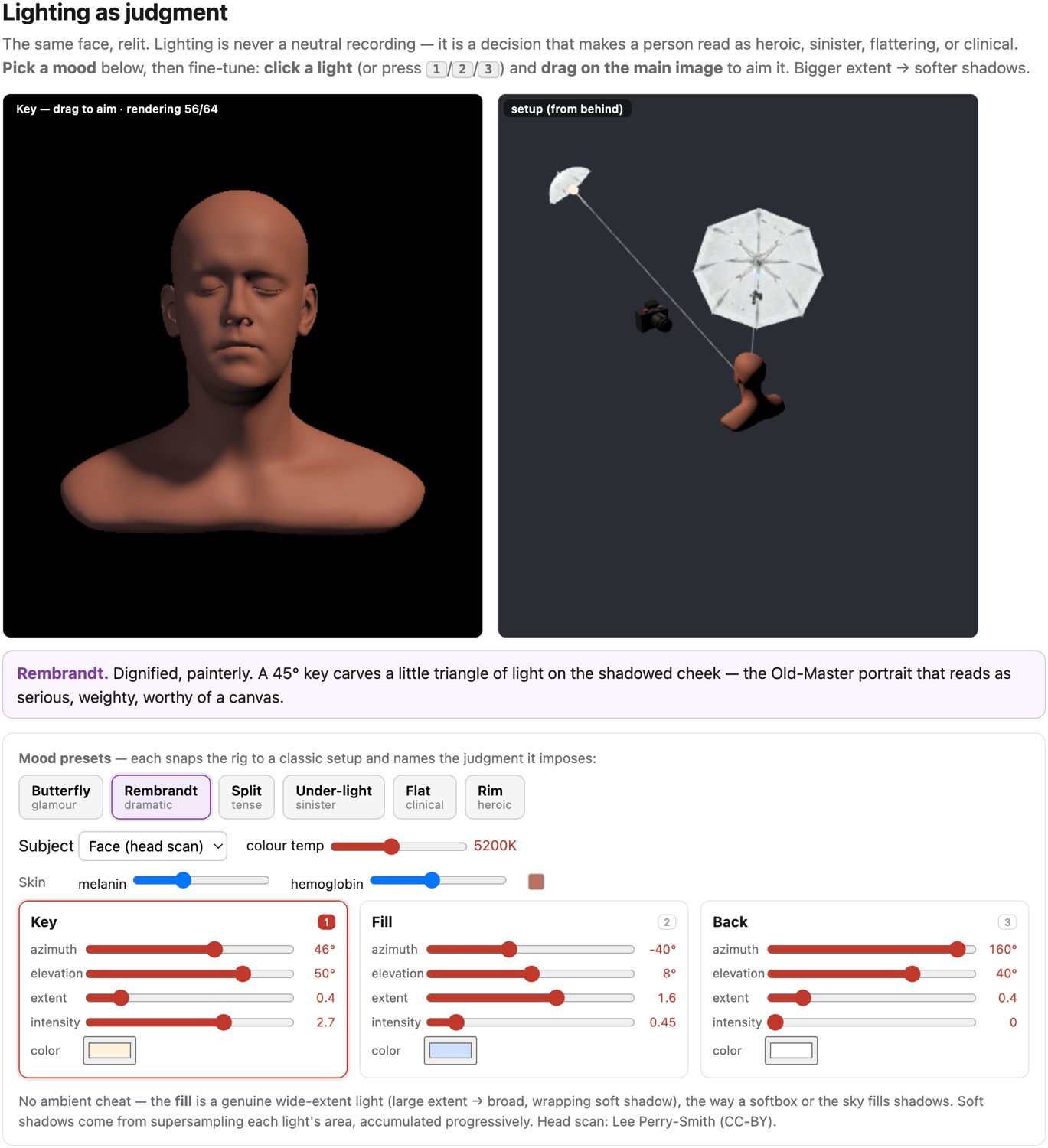
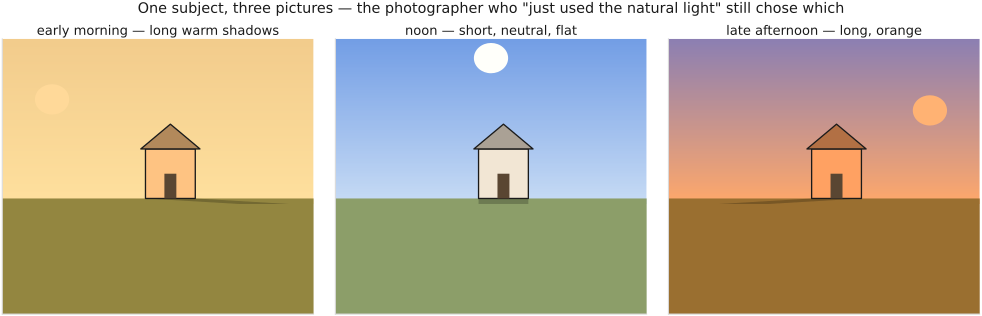
Lighting is where the constructed nature of the image is least deniable, because lighting has five jobs and not one of them is neutral: provide enough light, fill the shadows, model the shape, reveal texture, and install ambiance. Even available light is a selection. It is a choice of the hour, the weather, and the orientation to the subject. The same building at 8 a.m., at noon, and at 4:30 p.m. is three different photographs of one unchanged subject (Figure 3.9.5). The grammar of light that reads as "natural" is, in studio and cinema, entirely built: three-point lighting, with a key light to model, a fill to open the shadows, a back light to rim the subject and lift it off the ground, plus a separate background light. "Painting with light," walking through a dark interior during a long exposure with a handheld lamp, makes the authorship literal: the light in the "record" was drawn by hand.
And lighting does not merely describe a subject. It can judge it. In The Godfather, Gordon Willis lit Don Corleone from above so that his eyes fall into shadow, and menace pools in the sockets. Arnold Newman, photographing the industrialist Alfred Krupp, who had used forced labor under the Nazis, deliberately chose hostile underlighting and a cold, symmetrical, almost satanic framing inside Krupp's own factory. The light encodes the photographer's verdict on the man (Figure 3.9.4). There is no neutral way to light a face; there is only a way, and it always says something.
3.9.5 The darkroom: tone, dodging, and burning⧉
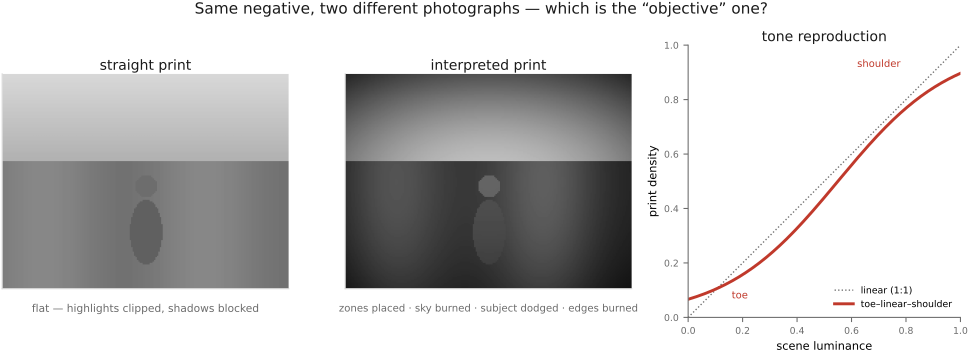
There is a tempting last refuge for objectivity: surely the print is a faithful copy of the negative? It cannot be. The print's contrast tops out around 1:300 while the scene's ran to 1:10,000, so there is no faithful one-to-one mapping available — the print must reinterpret the scene's tones to fit (the contrast limit). Tone reproduction does this with the gentle toe–linear–shoulder characteristic curve and gamma; the Zone System does it deliberately, the photographer pre-visualizing each tonal zone and placing it where it should land in the print (Adams, The Negative).
The negative, in this light, is only raw material. W. Eugene Smith's portrait of Albert Schweitzer famously took five days to print. That was five days of interpretation. Dodging (holding back light to lighten a region) and burning (adding light to darken one) reshape each print area by area: Ansel Adams burned the sky of Clearing Winter Storm heavily to give it weight, and edge burning darkens the borders to hold the viewer's eye inside the frame. The "same" negative yields as many different truths as there are printers and intentions (Figure 3.9.6). The darkroom is not a copier; it is a studio.
3.9.6 Make-up and retouching: authoring the subject⧉
The remaining controls reach past the image to the subject itself. Make-up is chiaroscuro by other means: corrective make-up hides lines and rebalances a face, and shading and highlighting re-sculpt it with light and dark pigment exactly as a painter models form — different contouring prescribed for different face shapes. The face in the photograph is, quite literally, a constructed object (it is the same problem that made early computer-generated-imagery (CGI) humans, like the people in the first Toy Story, look wrong: a face is not a neutral given).
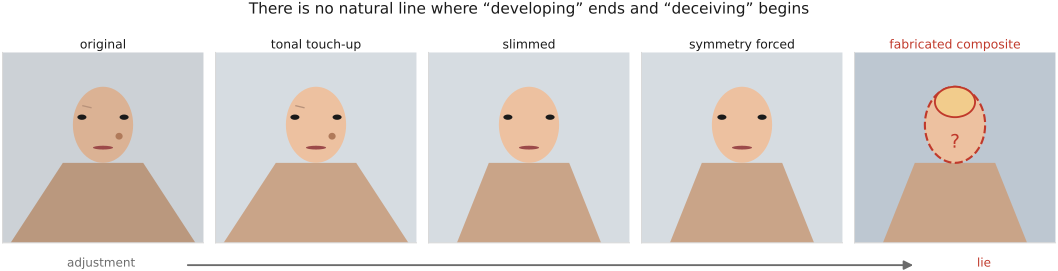
And then retouching alters the recorded image directly, along a continuum that has no clean boundary on it. Brighten a too-dark face; slim a silhouette; remove a distracting line; stretch a limb; force a pair of lips or a whole face into symmetry; composite one person's head onto another's body (the notorious TV Guide "Oprah" cover); airbrush an inconvenient official out of a state photograph. Is it fair? The question has no single answer, and the chapter does not pretend to give one. It hands the continuum, from defensible adjustment through manipulation to outright fabrication, forward to image forensics and to the ethics chapter (Figure 3.9.7). The point here is only that the continuum is continuous: there is no natural line at which "developing the photograph" ends and "altering it" begins, because authoring was happening the entire way along.
3.9.7 Getting closer — systematic capture, and the biases that remain⧉
The title says photographs are usually not passive recordings, and the hedge is deliberate, because there are real efforts to get closer to a comprehensive, objective record. Google Street View and its kin drive a rig along every road and fire on a fixed schedule, with almost no per-frame human choice; satellite and aerial mapping, gigapixel panoramas, cultural-heritage scanning, scientific survey imaging (astronomical sky surveys, microscope slide scanners), and 360° capture all push the same way: automate the shutter, cover everything uniformly, take the photographer's moment-to-moment decisions out of the loop. At the limit, a light field even defers focus and viewpoint to the viewer, handing back the choices a single photograph had frozen (Light fields 101). These are genuine moves toward a less authored, more exhaustive record. That is why the claim is "usually," not "never."
But the choices do not vanish; they move up a level, from the individual frame to the system, where they are harder to see precisely because they look like neutral infrastructure. Street View still chooses which roads and neighborhoods to drive and when (sunny days, certain hours, denser and wealthier areas first); it chooses to blur faces and license plates. That is a value judgment about privacy baked into the "objective" record; its stitching and exposure are an interpretation. The per-shot decisions of the sections above become aggregate, statistical decisions about coverage and processing. They are no less authored for being made once, at scale, by a policy rather than a finger on a shutter.
Two forms of this systemic authorship matter enough to name, because they propagate silently into every computational pipeline trained on images:
- Dataset bias. The giant image datasets that modern vision and generative models learn from, including web-scraped collections, ImageNet and its successors, are not a uniform sample of the world. They over-represent some places, people, and contexts and under-represent others (wealthy, English-speaking regions; certain demographics; "canonical" framings of objects). A model trained on them inherits that skew as if it were ground truth. Bias in, bias out: the skew surfaces as worse recognition for under-represented groups, stereotyped generations, and brittle behavior away from the dataset's center of mass. A dataset is a prior (Image priors), and a biased dataset is a biased prior: the statistical descendant of this chapter's whole argument, that the "objective" record was assembled by choices, and the choices have consequences.
- Photographer bias. Who stands behind the camera shapes what is recorded. Historically, photography skewed toward particular subjects, occasions, and points of view, so the photographic record of an era is really a record of who got to photograph what. It reaches into the technology itself: color film and printing were long calibrated to lighter skin (the notorious "Shirley card" reference standards), so the medium literally rendered some skin tones better than others. Early auto-exposure and face detection inherited the same skew. Even the framing conventions a photographer absorbs, including what counts as a "good" composition or a "neutral" portrait, are learned, cultural, and therefore partial.
So the drive toward comprehensive capture is real and it narrows the gap, but it relocates the authorship rather than removing it, and at scale the stakes rise: a single biased photograph misleads one viewer, while a biased dataset or capture policy quietly shapes what millions of downstream images and models treat as normal. The clear-eyed stance is the same as before, with the volume turned up. Ask whose choices made this record, and to what end, and remember that "the camera did it automatically" is not an answer, only a way of hiding the question.