3.4 Cameras⧉
With exposure, lenses, and focus in hand, we can look at the camera as a whole machine, and at the space of machines. This chapter walks the viewfinder and its overlays, the anatomy of a mirrorless body and of a phone, the direct comparison between the two, the wider taxonomy of camera types, the many cameras that measure rather than photograph, and the suite of non-imaging sensors that increasingly feed the picture.
3.4.1 UI and display⧉
A camera's controls are abstractions; its viewfinder and display are where those abstractions become visible feedback. This is what mirrorless changed (Figure 3.4.1).
Viewfinders. An optical viewfinder (OVF), the SLR's mirror-and-prism or a rangefinder's window, shows the real world directly: zero lag, infinite resolution, but it does not show the captured exposure or white balance, only the scene. An electronic viewfinder (EVF) (and the rear LCD) shows the sensor's live feed instead: slightly laggy, but what-you-see-is-what-you-get. Exposure, white balance, and even a depth-of-field preview are all visible before you press the shutter.
Exposure preview and the live histogram. Because the EVF or LCD can simulate the captured image, it can overlay a live histogram to judge clipping in real time. This is where ETTR is most useful: push the histogram to the right without letting the highlights pile up against the right edge.
Focus aids. For manual focus, focus peaking highlights the high-contrast (in-focus) edges, and a magnify mode zooms in to check critical focus. For exposure, zebras, animated diagonal stripes over near-clipped highlights, borrowed from video, warn you before you blow out the brights.
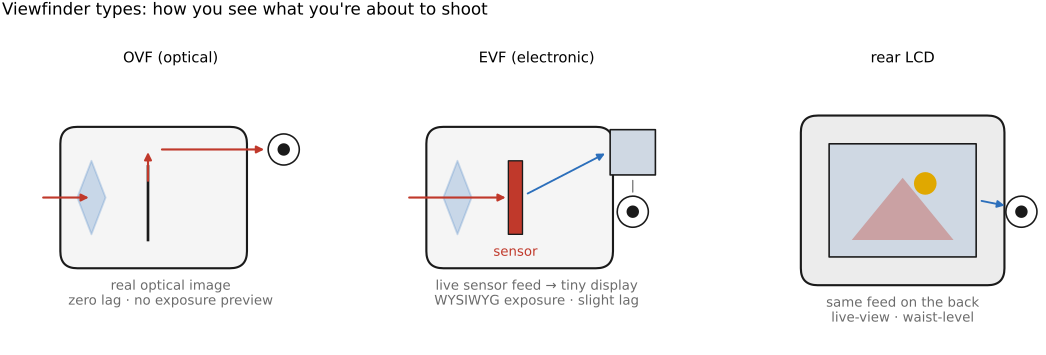
The throughline: an EVF turns the abstractions of exposure and focus into direct visual feedback, which is why mirrorless changed how people shoot. You stop guessing and start seeing the photograph before you take it.
3.4.2 How the viewfinder works⧉
The section above said what each finder shows; it is worth seeing how each is built, because the viewfinder is a small optical instrument in its own right and its mechanism explains its quirks.
The SLR pentaprism. The reflex finder solves a specific problem: let the photographer look through the taking lens so there is no parallax and focus is exact, without the film in the way. A mirror at 45° behind the lens intercepts the image and folds it upward onto a focusing screen (the ground glass of the previous chapter) placed at a plane the same optical distance from the lens as the sensor, so what is sharp on the screen is sharp on the sensor. But that screen image is inconvenient to read: like any lens image it is upside-down, and having been reflected up it is also flipped left-to-right. The pentaprism, a five-sided roof prism sitting above the screen, fixes both. Its faces reflect the light three times (one face is a "roof" of two surfaces at 90° that swaps left and right), and the net effect of the folded path is to erect the image to fully upright and correct handedness before it exits the eyepiece. So you see the world the right way up and the right way round, through the lens, at the working focus. The prism also raises the eyepiece to a comfortable position and, being solid glass, is bright. Its costs are weight and price, which is why cheaper bodies substitute a pentamirror: the same geometry made of a hollow shell of mirrors instead of a glass block, lighter and cheaper but dimmer, since each air-mirror reflection loses more light than a total-internal-reflection bounce inside glass. At the instant of exposure the mirror flips up (blacking out the finder) and the shutter opens; this is the one big moving part that mirrorless removes.
Two numbers describe an optical finder. Coverage is the fraction of the actual frame the finder shows, from about 95% on consumer bodies (you get slightly more in the picture than you saw) up to 100% on professional ones. Finder magnification is how large the scene appears through the eyepiece compared with the naked eye, which sets how immersive and how easy to focus the view is.
Direct optical finders. A camera without a reflex mirror can still carry a cheap optical finder that does not look through the taking lens: a little reverse-Galilean telescope (a negative front lens and a positive eyepiece) that simply frames the scene, as on point-and-shoots and disposable cameras. Because it sits beside or above the lens, it sees from a slightly different viewpoint, so it suffers parallax (its framing drifts from the lens's, badly up close) and it shows neither focus nor exposure. The rangefinder finder is a refined version of this window: it adds bright-line frames for the field of view and the superimposed coincidence patch that focuses the lens by triangulation (the previous chapter). The old waist-level finder of a twin-lens reflex or a medium-format SLR is the most direct of all, you look straight down onto the ground-glass screen with no erecting prism, so the image is upright but laterally reversed, which is why photographers using them learn to pan the "wrong" way.
The electronic viewfinder. An EVF throws all of this glass away. It is a tiny, dense microdisplay, an OLED or LCD panel a centimeter or so across with millions of dots, viewed through a simple magnifying eyepiece, and it is fed the live, processed sensor feed. There is no mirror, no prism, and no optical path from the lens to the eye at all: the finder is a small television. That is what lets it overlay the live histogram, focus peaking, and a WYSIWYG preview of exposure and white balance, and it is why its limits are electronic rather than optical, refresh rate and lag, the panel's resolution and dynamic range, and power draw, rather than coverage and prism brightness. The rear LCD is the same idea at arm's length. The progression from pentaprism to EVF is the chapter's theme in miniature: an optical mechanism of remarkable ingenuity, replaced by a sensor and a screen that do the same job and then far more.
3.4.3 Anatomy of a modern full-frame interchangeable-lens camera⧉
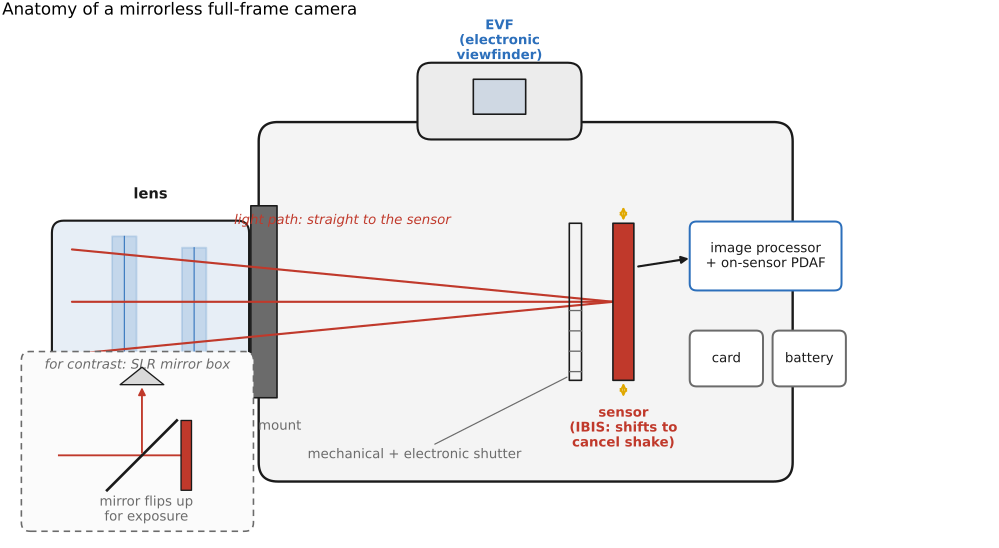
It helps to see the whole machine at once, because each block is a previous section made physical (Figure 3.4.2). Trace the light from front to back through a modern mirrorless body:
Lens and mount (electronic contacts carry autofocus, aperture, and stabilization signals) → sensor on an IBIS stage (the moving sensor of the stabilization section) → shutter (a mechanical curtain and/or an electronic rolling shutter, the readout of the sensor chapter) → image processor and AF: on-sensor PDAF, subject detection, and the image signal processor (ISP, the computational pipeline of the next part) → EVF and rear LCD (the live feed of the UI section) → card and battery.
The defining change from the single-lens reflex (SLR) is that the mirror box and optical prism are gone. In an SLR, a 45° mirror bounced the lens's image up into an optical prism and the OVF, then flipped up out of the way at the instant of exposure. Remove it, and the sensor feeds the EVF directly. That enables WYSIWYG preview, on-sensor PDAF spread across the whole frame, a silent electronic shutter, and a shorter lens-to-sensor (flange) distance that allowed the new, smaller lens mounts. The mirrorless body is the SLR with its one big moving part removed and the sensor promoted to do the viewfinder's job.
3.4.4 Anatomy of cell-phone cameras⧉
A phone reaches the same goal, a good photograph, by a very different route. Its hardware is constrained: a tiny sensor behind a bright, fixed-aperture lens. There is no iris, so exposure is set by shutter and ISO alone. The tiny sensor has two consequences that fall straight out of earlier chapters: depth of field grows as the sensor shrinks (the lens chapter), so a phone has enormous depth of field and must fake background blur; and a small sensor collects fewer photons, so it has more noise and must burst-and-average to clean it up.
Where a camera uses a zoom lens, a phone uses a multi-camera array: separate ultrawide / wide / tele modules, the long end often a periscope that folds the light path sideways with a prism so a long focal length fits a thin body. "Zooming" really means switching cameras (with cropping and fusion in between).
The computational pipeline makes up for optical limits: demosaicking, multi-frame high dynamic range (HDR; the HDR+ pipeline) and burst denoising, computational bokeh (depth from the dual-pixel split or the multi-camera array), night mode, and super-resolution. The phone overcomes small-sensor physics with computation rather than glass. This foreshadows the Basic ISP and Multiple-exposure parts, where these algorithms live. This bridges to the rest of the book: for many everyday photos, simple optics plus computation can beat optics alone.
3.4.5 Camera versus phone⧉
With both anatomies on the table, it is worth lining them up axis by axis, because the contrast motivates this book, and it is not a simple "the camera is better" story. Each wins on different axes, and the phone wins on exactly the ones that turn out to matter most for everyday pictures.
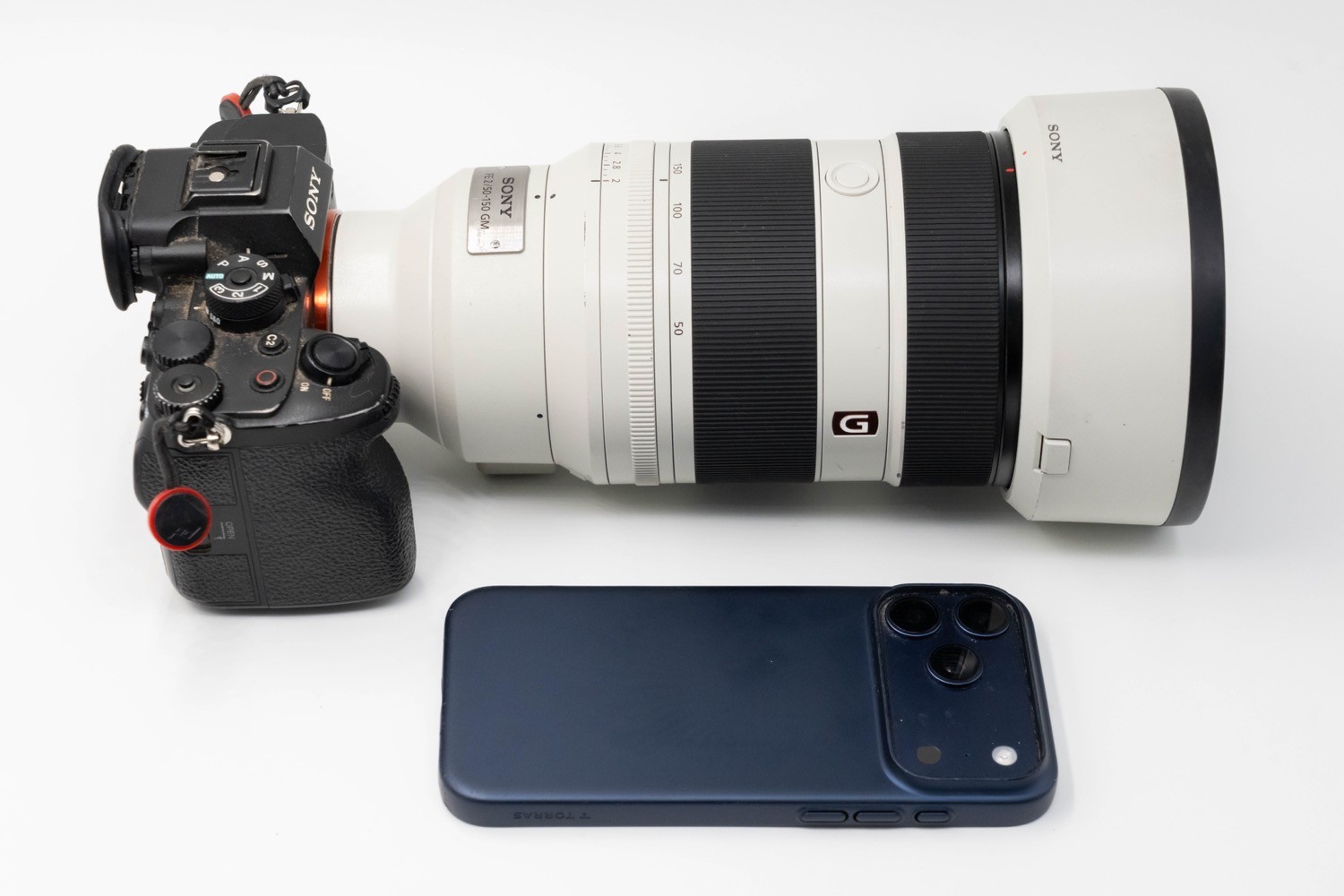
- Optics. The camera wins outright on optical quality and flexibility. The reason is straightforward. It has a variable iris (diaphragm) you can stop from $f$/1.4 down to $f$/16, interchangeable lenses, a true continuous optical zoom, and large ground-and-polished glass elements. A phone has none of these. Its lenses are fixed primes (no zoom), and usually a fixed aperture: most phones have no diaphragm at all (a handful of flagships have added a crude two-position or variable iris), so they cannot stop down to gain depth of field or sharpness. And they are molded plastic, not ground glass. Molding is cheaper and lower in absolute quality, but it has one advantage: it makes steeply aspherical element shapes (very hard to grind in glass) easy, which is how a stack of a few millimeters of plastic corrects aberrations as well as it does. The phone lens is also nominally "fast" ($f$/1.6–1.8). But that is the f-number $N=f/D$, and with a focal length of only ~6 mm the physical aperture diameter $D$ is about 3.3 mm (area ≈ 8.6 mm²), against a 50 mm $f$/1.8 lens's 28 mm ($\approx$ 615 mm²). The big lens therefore gathers on the order of 70× more light per second, and feeds a far larger sensor. That largely explains its cleaner files and its real shallow depth of field, the latter something the phone can only fake.
- Sensor. The camera wins on every axis that silicon area buys. A full-frame sensor is about 864 mm²; APS-C ~370 mm²; a 1-inch compact ~116 mm²; a phone's main sensor only ~45–70 mm² (roughly $1/1.3$-inch) — so 12–18× smaller in area, and in total light collected, hence the camera's lead in dynamic range, low-light, and single-shot noise (the sensor and noise chapters, unchanged). Resolution is the exception: phones often win on megapixels — 48, 50, even 200 MP against a camera's 24–60 MP — by packing sub-micron photosites. In good light, after remosaicing, that resolution is genuine; in low light those same tiny pixels are binned back down. So "more megapixels" and "better image quality" point in opposite directions here. This is exactly the confusion the sensor-size discussion exists to dispel.
- Zoom and framing. A camera zooms optically and continuously. A phone "zooms" by switching between a few fixed modules (ultrawide / wide / tele) and cropping in between, and a crop is a zoom geometrically (cropping equals a longer focal length), but it discards pixels, so past the longest real module it degenerates into digital zoom: pure upscaling, increasingly synthesized by computational super-resolution rather than resolved by glass.
- Compute. Here the phone wins, and decisively. A phone carries an image-processing SoC (CPU, GPU, ISP, and a neural accelerator of tens of TOPS) that runs a heavy computational pipeline on every shot in real time; a traditional camera has a comparatively modest processor aimed at finishing a raw, not at burst fusion and learned enhancement.
- Connectivity. The phone is always online: instant upload, cloud processing, sharing, and backup, where a camera is an island that needs a cable or a card. Connectivity is also what lets a phone offload heavy computation and pull in updated models.
- Programmability and ecosystem. This is the deepest difference. A phone is an open, programmable platform: an operating system, app stores, camera APIs, frequent software updates that improve the camera you already own. A camera's firmware is closed and essentially frozen at purchase. That openness is why HDR, night mode, computational bokeh, and panorama all appeared and matured on phones first. Anyone could write (and ship to billions) the software, and the pipeline kept getting better without new hardware.
The main point is that a phone concedes optics and sensor (the things glass and silicon area buy) and wins on compute, connectivity, and programmability (the things software buys). For the pictures most people take most of the time, the second list wins, which is precisely why computational photography is where the field went.
3.4.6 Types of cameras⧉
The two anatomies above, a full-frame mirrorless body and a phone, are just two points in a much wider space. It helps to lay that space out along a few axes, because they are the axes a photographer actually shops along (Figure 3.4.5).
By sensor size, which is the main axis of the taxonomy, because sensor size is what sets depth of field, light-gathering, and body bulk (cross-reference the crop factor of the Pinhole chapter). From smallest to largest: phone → 1-inch compacts → Micro Four Thirds → APS-C → full-frame (35 mm) → medium format → large-format / view cameras. Each step up gathers more light and shrinks depth of field at the same framing, and each makes the camera bigger and dearer.
By lens. Cameras split into fixed-lens (phones, compacts, bridge/superzooms, instant cameras) and interchangeable-lens (ILC) bodies (mirrorless, DSLR, medium format) where you swap optics for the job.
By mechanism and viewfinder. The DSLR (a reflex mirror feeding an optical viewfinder) is the legacy design; mirrorless (an EVF fed by the live sensor) is now dominant; see the anatomy above. Around them sit the rangefinder (a Leica-style window with a focus patch), the point-and-shoot / compact, the bridge / superzoom (a fixed, enormous-range zoom on a small sensor), the rugged action / 360 cameras (ultrawide, fixed), the instant camera (Polaroid / Instax, a self-developing print), still-made film bodies (→ the darkroom below), and the view / technical camera (large format with movements → tilt-shift, deferred to Optics).
By platform — how the camera is carried (aerial photography). A camera also gets classified by where you put it. The modern default for getting above a scene is the drone / UAV, a gimballed camera that flies. But it caps a long lineage of lifting a camera when no tripod will reach: balloon photography (Nadar over Paris, 1858), kite aerial photography (Arthur Batut, 1880s, with a timer or altitude trigger firing the rig), pigeon cameras, and pole / mast photography for low overhead frames. The platform buys a viewpoint, not a different sensor. It is the same imaging, simply lifted.
The practical lesson is that sensor size and lens system, not megapixels, are what mostly separate these cameras; the rest is ergonomics, platform, and price.
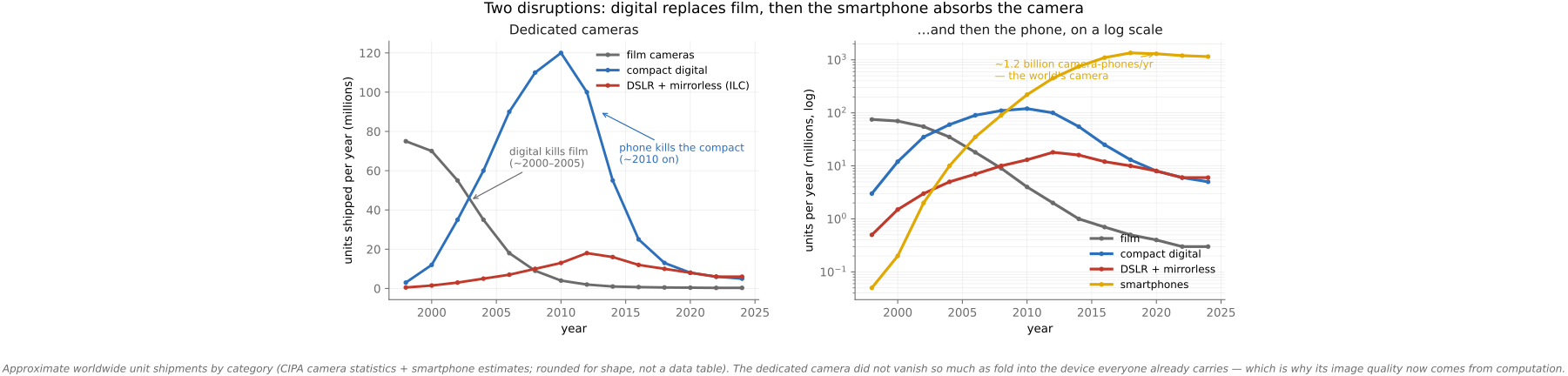
It is worth seeing how the population of these cameras has shifted, because the whole premise of this book sits in that history (Figure 3.4.4). Two disruptions, back to back: digital replaced film around 2000–2005, and then the smartphone absorbed the dedicated camera, first the compact (which collapsed from ~120 million units a year around 2010 to a handful), then eating into everything but the enthusiast interchangeable-lens bodies. Today well over a billion camera-phones ship a year against a few million dedicated cameras: the world's camera is a phone, with a tiny sensor and a huge computer, which is precisely why image quality migrated from glass to computation.
3.4.7 Cameras beyond photography⧉
Most of the cameras in the world never make a picture for a human to look at. Their image is an input to a decision or a measurement. They use the same optics and sensor, but pointed at a different goal (speed, a spectral band, geometry, reliability) and producing a different output (a number, a position, a defect flag). This is the hardware counterpart of the Introduction's insistence that the field extends beyond photography (Figure 3.4.6).
- Industrial / machine vision. Defect inspection and line metrology on a factory belt, often global-shutter monochrome sensors with fixed lighting and a GigE/USB3 link. The "image" is really a pass/fail or a measurement, computed and discarded in milliseconds.
- Barcode & QR readers. The dedicated retail and warehouse scanner, and the QR / barcode reader now built into every phone camera, is a camera used as data input: a tiny computer-vision pipeline that locates, rectifies, and decodes a 1-D or 2-D code into a number or a URL, never keeping a picture at all.
- Robotics & drones. Cameras for SLAM (simultaneous localization and mapping), obstacle avoidance, visual-inertial odometry (a camera fused with the IMU), and grasping; the output is pose, depth, or a control signal, not a photograph.
- Automotive (ADAS / self-driving). Surround cameras fused with radar and lidar for lane-keeping and sign/pedestrian detection, where high dynamic range and reliability matter far more than prettiness.
- Scientific & specialty. Microscope and telescope cameras, high-speed cameras, thermal / multispectral / hyperspectral imagers, and event cameras (per-pixel brightness-change sensors), several revisited in the Advanced part.
- Cooled astronomy cameras. Dedicated deep-sky cameras actively refrigerate the sensor, a thermoelectric Peltier stage holding it at a fixed set-point tens of degrees below ambient, to crush the dark current that would otherwise swamp a minutes-long exposure (the thermal-noise term of the sensor chapter, attacked with a fridge). They are typically monochrome (paired with a filter wheel for LRGB or narrowband), temperature-regulated so that calibration dark frames match the lights, and built with no IR-cut filter and no Bayer mosaic for maximum sensitivity. Cross-reference denoising-by-averaging (frame stacking) and the noise section.
- Medical. Endoscopes, retinal and surgical cameras, swallowable capsule cameras — imaging in the service of diagnosis.
- Ubiquitous & embedded. Webcams and video-conferencing, AR/VR inside-out and eye tracking, doorbell and CCTV security, automotive cabin sensing, with cheap modules that rely heavily on computation.
The throughline, echoing the Introduction: once a camera is a measurement device, "good" stops meaning pretty and starts meaning accurate, fast, and reliable for the task at hand.
3.4.8 A camera's other sensors⧉
The image sensor is not the only sensor in a modern camera. Tucked around it is a small suite of others, and several of them feed straight into the computational pipeline rather than just decorating the metadata.
The most important is the inertial measurement unit (IMU), a tiny accelerometer (sensing linear acceleration and, through gravity, which way is down) and a gyroscope (sensing angular rotation). It is the camera's sense of its own motion, and it does real work: it drives the stabilization of the previous section (the gyro tells OIS and IBIS exactly which way to counter-shift), it auto-rotates the picture and levels a horizon overlay, and increasingly it is an input to computation. It feeds video stabilization (EIS), seeds the frame-to-frame alignment in burst and panorama modes so the software starts from a good guess, and even informs gyro-based deblurring, where knowing the camera's motion during the exposure helps estimate the blur kernel (forward-referenced to the deblurring and motion chapters). The IMU is why a phone, which cannot afford a heavy stabilized lens, can still hand-hold a long night-mode exposure.
The rest of the suite is mostly about context and metadata:
- GPS / GNSS: geotags each photo with where it was taken (latitude, longitude, sometimes altitude), written into the EXIF (→ the EXIF metadata discussion in Image representation).
- Magnetometer (compass): gives heading, so a geotagged photo can also record which direction the camera was pointed; essential for augmented reality and map alignment.
- Barometer: estimates altitude from air pressure, refining the GPS fix.
- Ambient-light sensor (ALS): a small non-imaging front photodiode, increasingly a multi-channel color / spectral version, that reads the level and color of the surrounding light. It is, in effect, a light meter sitting beside the imaging sensor, but pointed outward at the room rather than at the scene. It does three jobs. It drives auto screen brightness (matching the display to the ambient light). It seeds a white-balance prior. Knowing what illuminant you are standing under is a strong head start for the camera's automatic white balance (→ white balance, Color technology). And a fast variant detects the flicker of mains-powered fluorescent and LED lighting, the $50/60$ Hz pulsing, so the camera can phase its exposures to dodge banding, the flicker-free or anti-banding mode.
- Dedicated focus and depth sensors: beyond the on-sensor PDAF of the focus section, many phones add a small laser / time-of-flight (ToF) rangefinder for fast low-light autofocus, and some a lidar scanner that builds a coarse depth map for portrait blur and augmented reality.
- Microphones: for video sound, but also repurposed: arrays give directional and wind-noise-aware audio, and the same stream synchronizes with the IMU for stabilization.
- Housekeeping sensors: a thermometer (the sensor's own temperature feeds dark-current and noise compensation, the thermal-noise story of the sensor chapter), Hall sensors that report the precise position of moving lens and stabilizer elements, and a real-time clock that timestamps every frame.
The throughline echoes the rest of the chapter: a camera is no longer just a lens and a sensor but a small sensor fusion platform, and the side channels, especially the IMU, are increasingly part of how the picture is computed, not just notes attached to it.