3.2 Lenses⧉
A lens is the camera's eye, and choosing and caring for it is half of photography. This chapter covers what a focal length is for, what fast and slow buy you, how a stabilizer fights camera shake, how to keep the glass clean, and the filters that change the light before it is ever captured.
3.2.1 Lenses and focal length⧉
Focal length sets the field of view. The geometry was derived in the Pinhole chapter, including the "35 mm" / crop-factor sidebar. Here we treat lenses as a photographer chooses them: what each focal length is for, and what fast/slow and prime/zoom buy you.
Primes versus zooms. A prime lens is one fixed focal length; for the same quality it is typically brighter (faster), sharper, smaller, and cheaper, and it "makes you think and move your feet." A zoom trades some of that for the convenience of many framings in one lens. A cheap fast prime, such as a 35 mm, 50 mm, or 85 mm at f/1.8, is some of the best value in photography: sharp and bright for the price. Modern zooms are excellent, but the basic kit zoom is usually a camera's weakest optical link.
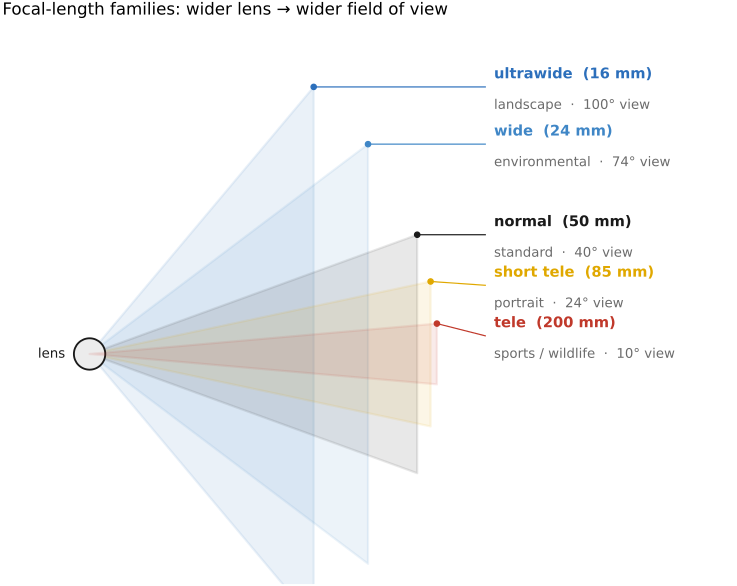
The focal-length families (quoted on full frame; remember the crop factor for smaller sensors), each with what it is for (Figure 3.2.1):
- ultrawide (≤24 mm): landscapes, interiors, exaggerated near/far, but watch the perspective stretch at the edges.
- wide (~24–35 mm): environmental and reportage work, "the subject and its context."
- normal (~50 mm): close to the eye's own perspective, unobtrusive, and usually fast and cheap.
- short telephoto (~85–135 mm): portraits: the working distance gives flattering proportions and easy subject separation (and the reason is distance, not the lens, see below).
- telephoto / super-telephoto (~200 mm and up): sports, wildlife, the moon, with strong compression bringing far subjects close.
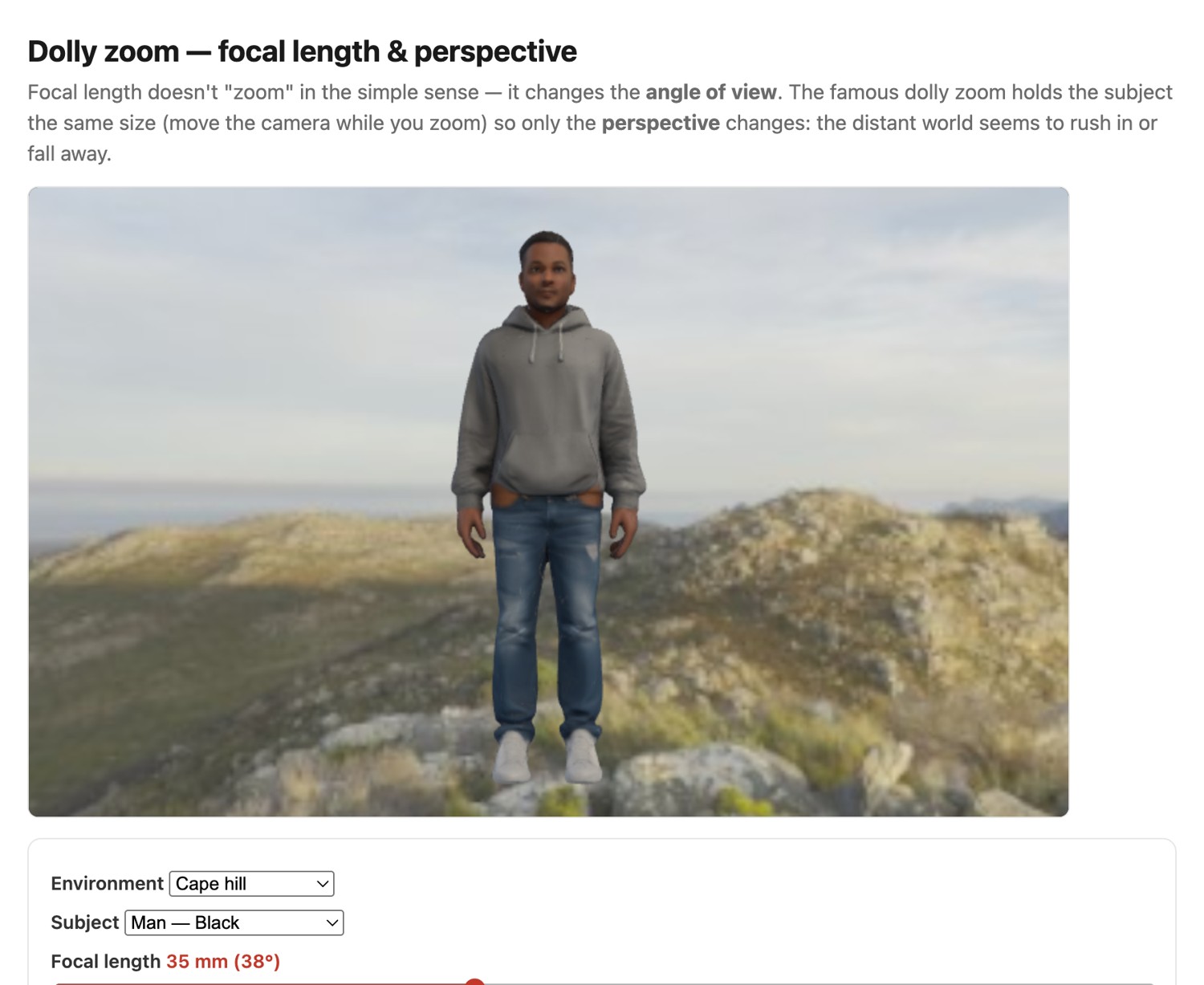
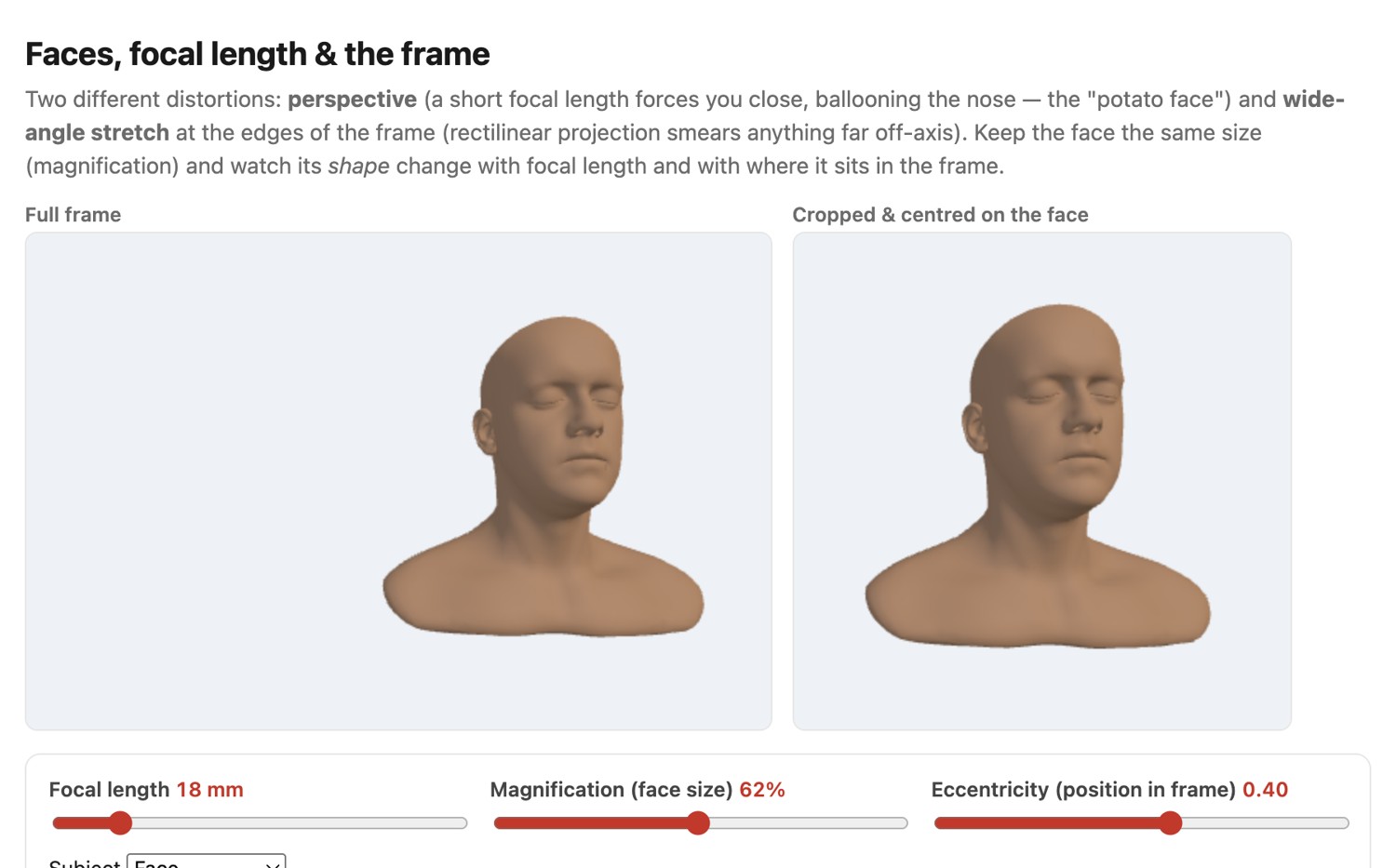
Why portrait lenses flatter — it is the distance, not the lens. It is tempting to credit the "portrait" focal length itself for flattering a face, but the lens is only an accomplice. What actually shapes a face is the camera-to-subject distance, and the same focal-length-versus-distance distinction the Pinhole chapter drew for backgrounds governs faces too. Up close, where a wide lens forces you to stand close to fill the frame, the nose is markedly nearer the lens than the ears, so by the perspective $1/Z$ falloff it looms: a bulbous nose, an inflated forehead, ears that recede into nothing. Step back and shoot from a few meters with a short telephoto and those front-to-back distances equalize, so the proportions read as natural. The "portrait" focal length (~85–135 mm) flatters precisely because, at a normal framing, it makes you back away to that comfortable distance; the longer focal length is just what crops the now-distant face back to a head-and-shoulders. The striking finding is that the chosen distance changes proportions and also affects perceived personality: in rating studies, faces shot from closer are judged less trustworthy, less competent, and less attractive. A sub-meter change in where you stand measurably shifts how a stranger is read (Perona 2007; Bryan et al.). A related case, the wide-angle face stretch when you cannot back away, as on a phone's selfie camera, and how to undo it computationally, is the subject of Perspective distortion and its correction.
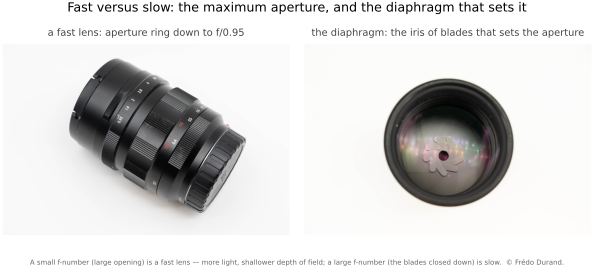
Fast versus slow. A fast lens has a large maximum aperture (small f-number, e.g. f/1.4), giving more light and shallower depth of field; a slow lens (f/5.6) is smaller and cheaper but light-starved. Zooms are often slow, and many have a variable maximum aperture that shrinks as you zoom in (e.g. f/3.5 wide, f/5.6 long). The "35 mm-equivalent" reminder is worth repeating but not re-deriving: a focal length only means a field of view relative to a sensor size, so smaller sensors crop and you multiply by the crop factor (APS-C ≈ 1.5×, Micro Four Thirds ≈ 2×, phones much more) to compare; see the Pinhole chapter's "35 mm" sidebar. Physically, the f-number is set by an adjustable iris of overlapping blades, the diaphragm, and "fast" just means the blades can open very wide (Figure 3.2.4): the fastest lenses reach f/1.2, f/0.95, even below, at the cost of size, weight, and price.
3.2.2 Aperture and the diaphragm⧉
The aperture is set by the diaphragm, an iris of overlapping blades that opens and closes to a roughly circular hole whose diameter $D$ fixes the f-number $N = f/D$ (the geometry and the exposure role are in Exposure; here we treat it as a control on the lens). Two numbers bracket what a lens can do. The maximum aperture (the widest opening, the smallest f-number) is the lens's headline "speed": more light and shallower depth of field, at the cost of size, weight, and price. It is often not a single number, because many zooms have a variable maximum aperture that shrinks as you zoom in, an $f/3.5$–$5.6$ kit zoom being $f/3.5$ at the wide end and only $f/5.6$ at the long end; constant-aperture zooms (an $f/2.8$ that holds across the range) are larger and dearer precisely because holding the pupil diameter proportional to a growing focal length takes bigger glass. The minimum aperture (the narrowest opening, the largest f-number, typically $f/16$ to $f/22$) exists for maximum depth of field and for cutting light, but it is soft: past a couple of stops down, diffraction (the diffraction limit) blurs the whole frame, so the smallest apertures trade sharpness for depth and are used sparingly. The blades themselves have a second job: their number and curvature shape the out-of-focus highlights and the sunstars on point sources (more, rounder blades give rounder bokeh; a given blade count sets the number of star points), taken up with bokeh. On stills lenses the ring usually clicks in third-stop detents; cine lenses are de-clicked for smooth aperture pulls during a shot.
A modern twist worth stating plainly: most phone cameras have no aperture control at all. The lens has a single fixed aperture (commonly around $f/1.8$) and no diaphragm to stop down, so exposure is set entirely by shutter and ISO. A handful of flagships have added a mechanical iris (two fixed stops, or a small continuous range), but they remain the exception. This is not merely a cost saving: at phone sensor sizes the depth of field is already enormous (a phone at $f/1.8$ has the depth of field of full frame near $f/12$), so a diaphragm would buy little, and the shallow-depth look people actually want is instead synthesized computationally in portrait mode (synthetic depth of field). The physical aperture has quietly become one more thing the small camera fakes.
3.2.3 Focusing the lens⧉
Focusing places the chosen subject's image exactly on the sensor. From the conjugate relation $1/f = 1/u + 1/v$, moving the focus means changing the image distance $v$ (by sliding the whole lens on a simple prime, or by shifting an internal group on a modern compound lens); the mechanics and the autofocus that drives them are the subject of the focus chapter and the OPTICS focus section. What the photographer meets are a few specs. The minimum focus distance (MFD) is the closest a lens can focus, measured from the sensor plane, and it sets the maximum magnification: a lens that focuses close reproduces a subject large, which is why macro lenses advertise their MFD and their 1:1 reach. Distinct from it is the working distance, the gap from the front of the lens to the subject, which is what you actually have to work in: at the same magnification a long macro lens gives far more working distance than a short one, room to light the subject and to keep from spooking an insect. The two differ by the length of the lens plus the flange distance, and it is the working distance, not the MFD, that decides whether you can physically get the shot.
Two further practicalities. Does focus hold when you zoom? On a true parfocal zoom (cine zooms, some professional photo zooms) it does: refocus once and the subject stays sharp across the whole range. Most consumer "zooms" are actually varifocal, their focus drifting as the focal length changes, and they lean on autofocus to re-acquire after every zoom, which is invisible in stills but shows up as a focus hunt in video. And at the cheap end, some cameras do not focus at all: the lens on a basic phone module, a webcam, or a disposable film camera is fixed-focus, parked permanently at the hyperfocal distance (hyperfocal distance) so that everything from roughly a meter to infinity falls within the depth of field. This only works because the small sensor and modest aperture give such deep depth of field that a single fixed setting covers most of the useful range, another case where small optics turn a limitation into an acceptable default.
3.2.4 Image stabilization⧉
A long exposure handheld blurs not only moving subjects but the whole frame, from the tiny tremor of your hands. Image stabilization fights that camera shake: a gyroscope senses the camera's angular shake and a feedback loop counters it during the exposure, letting you hand-hold slower shutter speeds, typically gaining 2–5 stops (so a shot that needed 1/100 s can succeed at 1/4 s). There are three implementations (Figure 3.2.5):
- Optical image stabilization (OIS): in-lens, a floating lens element shifts to counter the shake (Canon's image stabilization (IS), Nikon's vibration reduction (VR)). Tuned per lens, it also steadies the viewfinder and the AF system.
- In-body image stabilization (IBIS): the sensor itself rides a moving stage and counter-shifts. It works with any mounted lens, can stack with OIS, and the same moving stage enables sensor-shift high-resolution modes.
- Electronic / digital image stabilization (EIS): crop a margin and warp each frame to cancel the motion. Cheap, with no moving parts (phones and video use it), but it costs resolution and field of view and can add a "wobble" artifact.
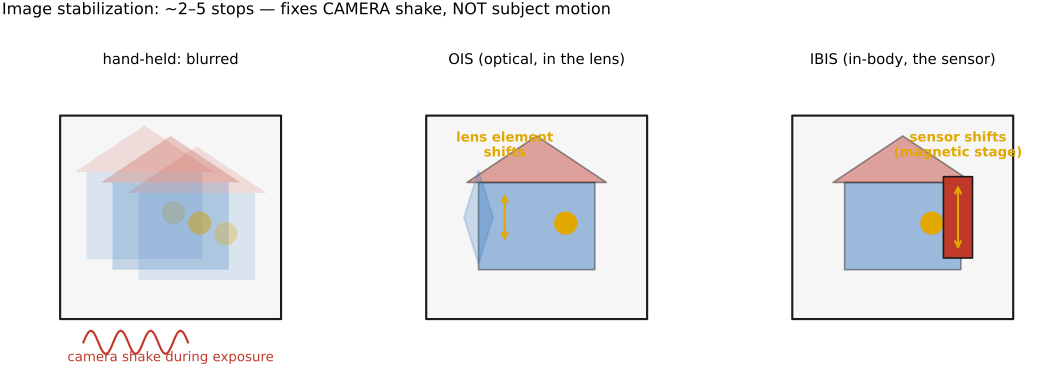
The crucial limit: stabilization fixes camera shake, not subject motion. A stabilized 1/4 s shot of a static scene is sharp, but a moving subject in that same frame still blurs; for that you need a fast shutter. This is a common beginner confusion, worth stating flatly: stabilization buys you slow shutters for still subjects only.
The stabilizer is, physically, a precise way to move the image during the exposure, so deliberate control turns it into a blur generator. Bando and Holtzman (ICCP 2011) used it for coded and custom motion blur, a hint that hardware meant to remove blur can be repurposed to shape it. We return to coded exposure in the Advanced part.
3.2.5 Keeping the lens clean⧉
A smudged or dusty front element is not just cosmetic; it is an optical problem. Stray light hitting the dirt scatters across the frame, producing veiling flare, lowering contrast, and casting soft dust spots (worst when stopped down, where the spots come into focus). Clean glass is real image quality, not fussiness.
There is an order of operations, gentlest first, because each step risks the delicate anti-reflection coating. Start with a blower to lift loose grit without dragging it across the glass; then a soft brush; then a microfibre cloth or lens pen; and only for stubborn smears, a drop of lens fluid. Wipe gently and from the center outward, and never dry-wipe a gritty element; that grinds the grit into the coating.
The companion warning is don't overdo it: every wipe is a small risk to the coating, and a little dust is optically harmless (it is far out of focus and scatters a negligible fraction of the light). A protective / UV filter or simply the lens hood prevents most of the problem in the first place. The cousin problem is sensor dust, but those spots sit in a fixed place in the frame (they do not move when you change lenses or zoom), which is the giveaway. Cameras fight it with an in-body ultrasonic shake of the sensor at startup; beyond that, a rocket blower or a wet swab cleans it, and dust-mapping lets software paint the spots out automatically (→ dust-spot removal, BASIC).
3.2.6 Lens filters: polarizers, ND, and graduated ND⧉
A few pieces of glass screwed onto the front of the lens change which light the sensor captures. The most interesting ones do something software cannot recreate afterward (Figure 3.2.6).
The circular polarizer (CPL). Natural light is unpolarized (its electric field oscillates in a rapidly varying mix of directions), but reflection off a non-metal surface, such as water, glass, or wet leaves, partially polarizes what bounces off it, and so does the blue sky (skylight is most strongly polarized in a band about $90°$ from the sun). A polarizer is a rotatable filter that passes only one polarization, so turning it lets you cut glare and reflections off those surfaces, deepen a blue sky, and boost saturation as the haze of scattered, polarized light is removed (this is the polarization of the Reflection sidebar, put to work). It costs about 1–2 stops of light, and it is "circular" (a linear polarizer followed by a quarter-wave plate), specifically so that the camera's beam-splitter-based autofocus and metering still see unpolarized light and keep working. Its effect is not reproducible in post: it changes the light before capture, so no slider can recover the un-glared, deep-sky image from a shot taken without it.
Neutral-density (ND) filters. An ND is a uniform gray that cuts the light by a chosen number of stops with (ideally) no color shift. It is a physical way to reduce light. Its point is to let you choose a setting you otherwise could not in bright light: a slow shutter for silky water or motion blur, or a wide aperture for shallow depth of field under a midday sun. Strong NDs (6–10 stops) make daytime long exposures possible; a variable ND is simply two stacked polarizers, rotated against each other to dial the strength continuously.
Graduated ND (GND). A graduated ND is dark at the top and clear at the bottom, with a hard, soft, or reverse transition. Lined up with the horizon, it holds back a bright sky so a high-contrast landscape fits inside a single exposure, an optical alternative to HDR bracketing (→ Image measurements; Multiple exposure), done in glass at capture time rather than by merging frames later.
UV / protective filters. A clear or UV filter today is mostly lens protection (it once cut UV haze on film); whether the protection is worth adding one more glass surface that can introduce flare is a perennial photographers' debate.
The section's main point is that the polarizer's and GND's effects are largely un-doable in software (the polarizer changes the captured light itself, and the GND is a per-shot exposure blend), which is exactly why these physical filters survive into the computational era, whereas a plain ND (which only scales brightness, something software can fake) is the one whose job a computer can take over.