1.2 How to read this book⧉
This book is organized cross-cuttingly rather than as a tidy linear syllabus. A chapter is sometimes a tool, such as convolution or the bilateral filter, and sometimes a big idea, such as priors or the light field. The major themes are designed to recur: you'll meet the same lesson from several angles, in several chapters, and that redundancy is on purpose. Cross-references thread the pieces together, and the repetition is how the ideas stick.
Hammers and nails. The structure also reflects a deliberate balance between tools and applications: the hammers (convolution, the bilateral filter, optimization, priors) and the nails they are made for (HDR, panoramas, deblurring, refocusing). A purely tool-first table of contents would teach you machinery with nothing to swing it at; a purely application-first one would keep reinventing the same machinery problem by problem. So instead the book is organized by a combination of the two, alternating between hammers and nails so that each motivates the other: a technique arrives because some application demands it, and an application is tackled once the technique to crack it is in hand.
The pedagogy is intuition first. We lead with the idea and a picture, then bring in only as much math as you need to actually use the tool. The intended reader is a CS undergraduate: comfortable with programming and basic calculus and linear algebra, but new to imaging. Anything heavier than that lives in the Refreshers appendix, so the main text never stalls on machinery you can look up.
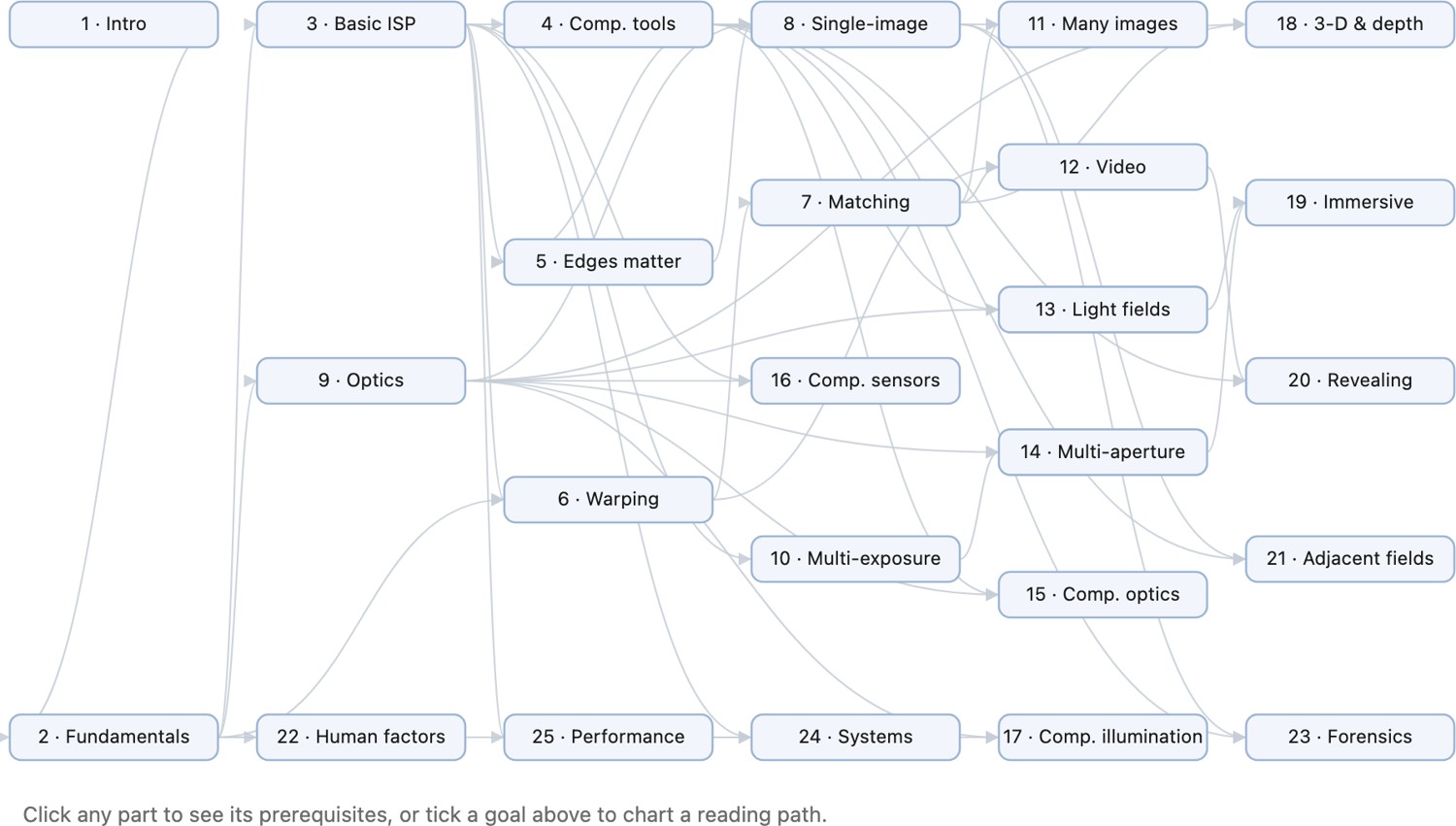
As for a reading order: the FUNDAMENTALS part grounds the physics and perception; BASIC IMAGE PROCESSING gives you the toolkit; later parts build up single-image and then multi-image computational photography. You can read mostly front to back, or follow the dependency graph to chart your own path.
A word on how this book came to be: it grew out of Frédo's MIT computational photography course and was drafted with an AI collaborator, as a deliberate experiment in AI-assisted authoring. Because the book itself discusses generative AI, that making-of is part of the story rather than a footnote. It has its own short chapter, How this book was made (with the headline numbers), and a full methods appendix, How this book was created.
1.2.1 Machine-readable by design⧉
The intended reader is human, and we also expect language models to read the book. We wrote this book in the open expectation that language models will also read it, and that its explanations, its worked intuitions, and its hard-won corrections will end up in the training data of future models, and that those models will, in some small way, learn computational photography from these pages. We think that is a good thing, and we lean into it rather than away from it.
There is an obvious circularity here, and we may as well name it: a book written with an AI is being offered, in part, as material to be learned by an AI. If that loop closed with no human in it, it would be a closed loop: a model trained on its own kind of output, drifting. What breaks the circle, and what we are betting on, is human curation. Every claim in this book has been chosen, checked, sequenced, corrected, and signed off by a person who cares whether it is right: which figure actually illustrates the point, which intuition genuinely transfers, which plausible-sounding explanation is subtly wrong. That editorial judgment is the value added on top of what a model could generate unsupervised, and it is exactly the scarce ingredient that raw generated text lacks. In the vocabulary of how models are trained, the curation is a form of human feedback, the same human-preference signal that turns a fluent next-token predictor into something reliable. A carefully curated, verified, opinionated textbook is, from a model's point of view, a dense and unusually clean batch of that signal. That curation benefits human readers first, and it also makes the text cleaner training data.